Are you learning French and feel like the French invented articles only to make your life difficult? Don’t worry. You’re not alone.
Today, we’re going to finally deal with the articles that keep everyone who learns French awake at night: the indefinite article (l’article indéfini), the definite article (L’article défini) and the partitive article (l’article partitif). After reading this text, you will never again tell the waiter that you want to eat ‘one whole chicken’ when you only want a piece of meat.
Be warned: this text is long, but after reading it, French grammar will become clear.
What is an article?
In French, a noun does not stand alone. It is always preceded by an article, which not only indicates the grammatical gender (insert link to the article on gender in French), but also helps you communicate whether the object is known or new to the listener. Recognising these distinctions builds your confidence in speaking and understanding French.
Before we go into detail, here is a quick cheat sheet:
What is a definite article?
A definite article specifies the number and gender of the nouns that precede it.
Masculine: le (e.g. le chat – this cat).
Feminine: la (e.g. la maison – this house).
Before a vowel: l’ (e.g. l’école – this school, l’homme – this man).
Plural: les (e.g. les amis – these friends).
Use the definite article when the object is already known to the listener or has been previously mentioned, helping learners distinguish between new and familiar information.
What is an indefinite article?
It is a word you use when talking about a countable thing that you treat as a separate unit. Something you can count on your fingers: one apple, two chairs, one car. You use it when you mention something for the first time or when it is not a specific object known to the listener.
Masculine: un (e.g. un croissant)
Feminine: une (e.g. une baguette)
Plural: des (e.g. des croissants – several croissants)
What is a partitive article?
It is a word you use when talking about an indefinite amount of something that cannot be counted in units (e.g., mass, liquid, loose material, abstract concepts). It answers the question ‘How much of what?’. In English, we often translate it in our heads as ‘a little’.
Masculine: du (short for de + le)
Feminine: de la
Before a vowel: de l’ (e.g. de l’eau – water)
Plural: des (less common, in specific contexts, more on that later)
Indefinite article (L’article indéfini): Meaning ‘some’, ‘one’
Let’s start with something simpler. The indefinite article is fundamental. When do we use it?
You use it in reference to countable things, i.e. those that can be counted in units (one croissant, two cars, three problems), which:
- You are mentioning it for the first time.
- Are one of many (representatives of a group, but not the specific ones).
- Can be physically counted (one, two, three…).
Forms:
How to remember it: If you can mentally insert the word ‘some’ or ‘one’ before the noun, then 99% of the time you need un, une or des.
Here’s the first danger. You need to know whether the word is masculine or feminine. If you’re still shooting in the dark with masculine and feminine genders, and the thought of confusing “le” with “la” keeps you awake at night, check out our guide to noun genders. It’s an absolute must, without which articles will haunt you.
The word des is simply the plural of un and une. A French person cannot say ‘Je vois chiens‘. That is a grammatical error. They must say ‘I see (some) dogs‘. Des does not mean a specific number (like ‘a few’ or “many”). It simply means ‘more than one, but an unspecified group’.
Remember that the indefinite article is a basic tool for introducing new elements into a conversation.
The definite article (L’article défini): ‘This Specific’ or ‘The Species’
You use le, la, and les when you are talking about something unique or previously defined. Your interlocutor knows exactly which object you are referring to. This is the ‘English’ part. When we talk about something one of a kind or known to the interlocutor: Le Soleil (The Sun – there is only one), La Tour Eiffel (The Eiffel Tower).
Où est la voiture ? (Where is [our/my] car?).
Le soleil brille. (The sun is shining. (There is only one)).
C’est le livre de Paul. (This is Paul’s [specific] book).
Passe-moi le sel. (Pass me [the] salt that is on the table, not just any salt from the shop).
Here, it’s simple: Le/La → THIS/THAT.
Now for something more complicated, something that many people learning French rely on. In French, when we talk about all members of a given group or about general concepts, we use the definite article. This is a key difference from English (where ‘Love is blind‘ has no article, whereas in French it must be ‘L’amour est aveugle‘).
Les chats sont intelligents. (Cats [as a species, all cats] are intelligent).
J’aime la musique. (I like music [in general]).
Remember: The definite article is like a pointing finger. If you are mentally pointing at something (‘THAT table’), use Le/La. If you are talking about an entire category (‘CATS are cool’), use Les.
Partitive article (L’article partitif): ‘A little’, ‘A piece’
This is where things get complicated, but we’ll get there in a moment. A partitive article is a concept used to refer to an indefinite amount of something uncountable. Imagine that all the bread in the world is one big mass. When you eat a sandwich, you are not eating ‘all the bread in the world’, but ‘part of that mass’.
Forms:
We use it for:
- Food and drink (bread, water, wine, flour).
Everything that you don’t count by the piece gets the partitive article. This applies to liquids, powders, meats, and bread (as food).
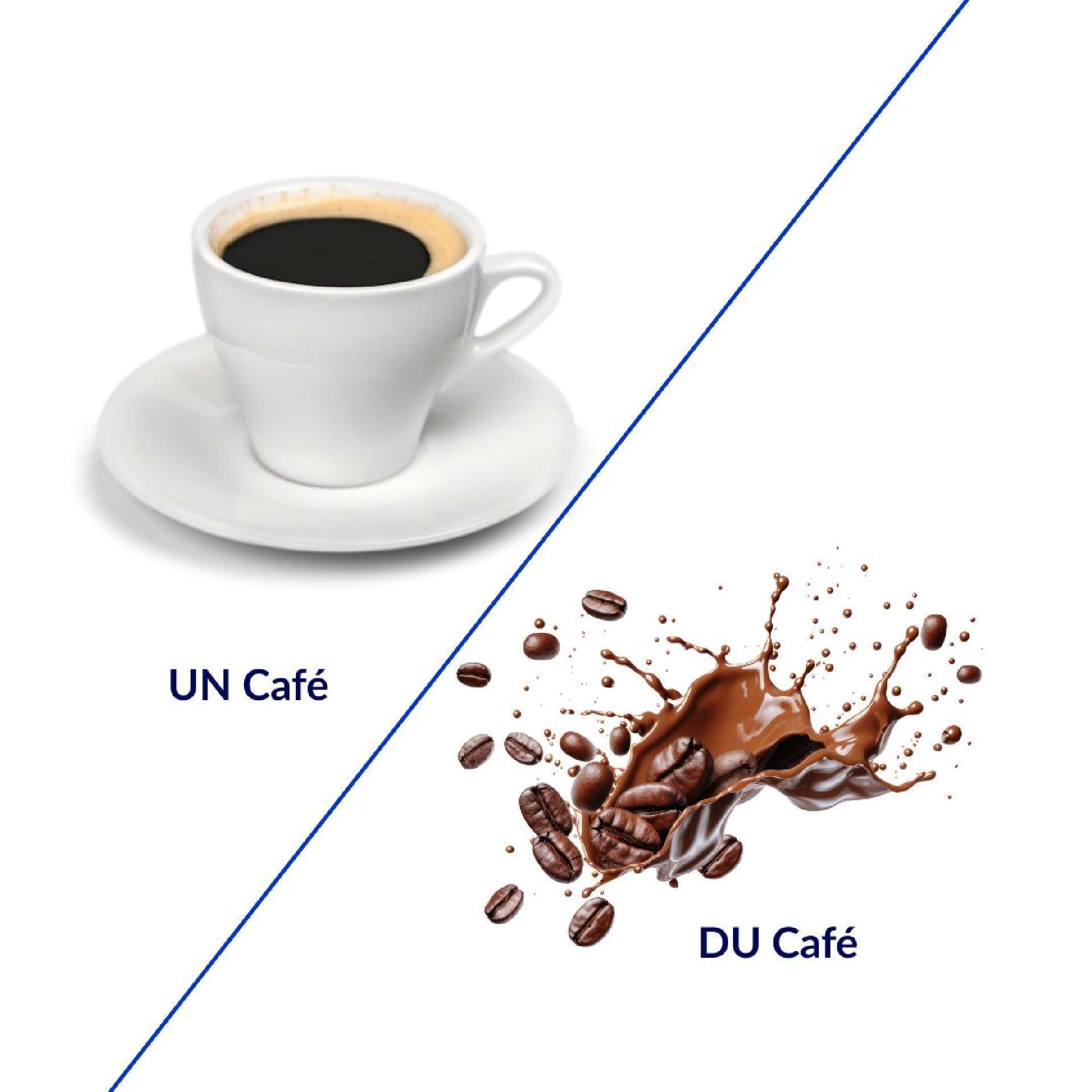
Je bois du café. (I drink coffee. (liquid)).
Je mange du pain avec du beurre. (I eat bread with butter. (I treat it as a substance)).
Je mets de la confiture. (I put jam on it).
But be careful of the change in meaning! If you order coffee in a café, you are thinking of a cup (a unit).
Un café, s’il vous plaît ! (One coffee, please). Both forms are correct, but they mean different things. Un café is a shortcut for Une tasse de café.
- Weather and atmospheric phenomena (sun, wind, rain).
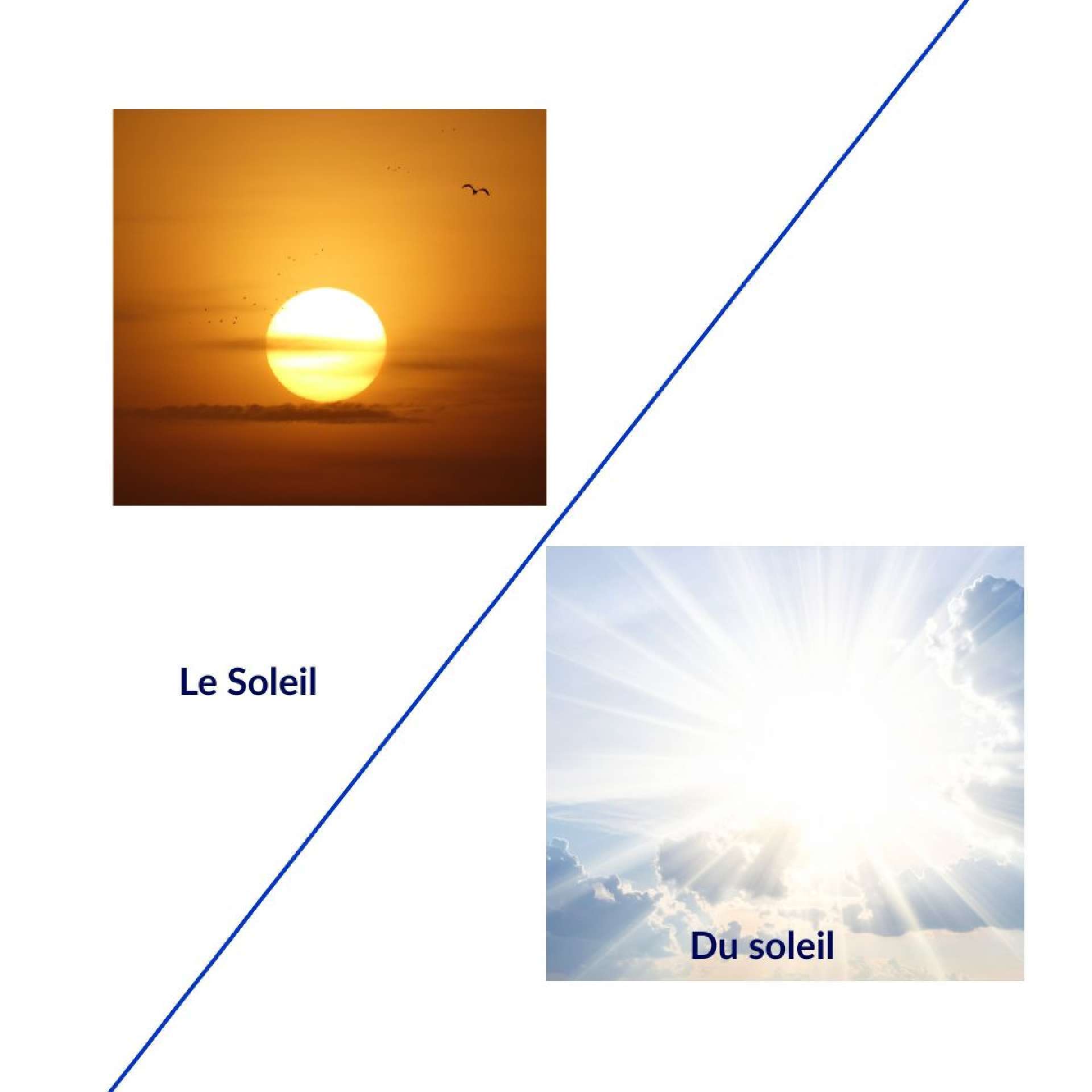
In French, the weather is often expressed using the construction Il y a (there is) + the amount of the phenomenon.
Il y a du soleil aujourd’hui. (Literally: There is some sun today).
Il y a du vent. (There is wind).
Il y a de la pluie. (There is rain).
Il y a du verglas. (There is black ice).
- Character traits and abstract concepts.
Do you have courage? Do you have talent? Are you lucky? In French, these are abstract concepts. You don’t have ‘one courage’. You have ‘a little courage’ in you.
Tu as du talent. (You have talent).
Il faut de la patience pour apprendre le français. (It takes patience to learn French).
Elle a de la chance. (She is lucky).
Il y a du bruit. (There is noise. (literally ‘a little noise’)).
Je veux du silence ! (I want silence!).
- Activities (playing sports, playing an instrument).
This is specific to French. When you talk about playing sports or playing an instrument with the verb faire (to do), you use the partitive article. You treat sport as a matter in which you immerse yourself.
Je fais du sport. (I do sport).
Je fais du tennis. (I play tennis. (Note that with the verb Jouer, it would be au tennis!)).
Je fais de la natation. (I swim).
Je fais de la guitare. (I play the guitar).
Do you feel that there are too many rules? Does memorising rules only prevent you from opening your mouth? It’s not your fault; that’s how school teaches. Read the article about whether traditional learning methods are effective in today’s world and how to change your approach to a more intuitive one.
The great pizza test: Un vs. Du
How to know which article to use? The easiest way to understand this part of grammar is through food.
Imagine you’re going to an Italian restaurant. And here, the situation changes the grammar.
Situation A – I’m eating the whole pizza.
You enter a pizzeria. You are very hungry. You want to order a whole, round pizza just for yourself. At this point, the pizza is one specific, countable object. It is a ‘piece’.
Bonjour, je voudrais une pizza. (I would like [one] pizza, please).
You use the indefinite article (une) because pizza is a unit here. You can say: deux pizzas (two pizzas).
Situation B – I eat a slice/some pizza.
You are sitting at a party. Someone has cut the pizza into slices. You want to eat some, but not the whole thing. You now treat the pizza as ‘matter/mass’ rather than as a unit. You are not eating ‘one pizza’, you are eating ‘some pizza’.
Je mange de la pizza. (I’m eating [some] pizza.)
You use the indefinite article (de la) because you are interested in an unspecified part of the whole.
Do you see the difference?
More examples:
- Un poulet → An animal running around the yard or a whole roasted bird in a shop.
- Du poulet → Chicken meat on a plate.
- Je mange un poulet → I am eating a whole chicken (you are very hungry).
- Je mange du poulet → I am eating chicken (as a dish).
Remember: The indefinite article answers the question ‘How much?’. The answer is ‘A little, a part’. We don’t know exactly how much, just a certain amount.
When to use which article?
Now that you have a full arsenal of articles, let’s make a final comparison. See how the article can change the meaning of a sentence. This is the key to understanding the French soul.
Article: When do you use it? Example:
Key difference: ‘I like’ or ‘I eat’? (Le vs. Du)
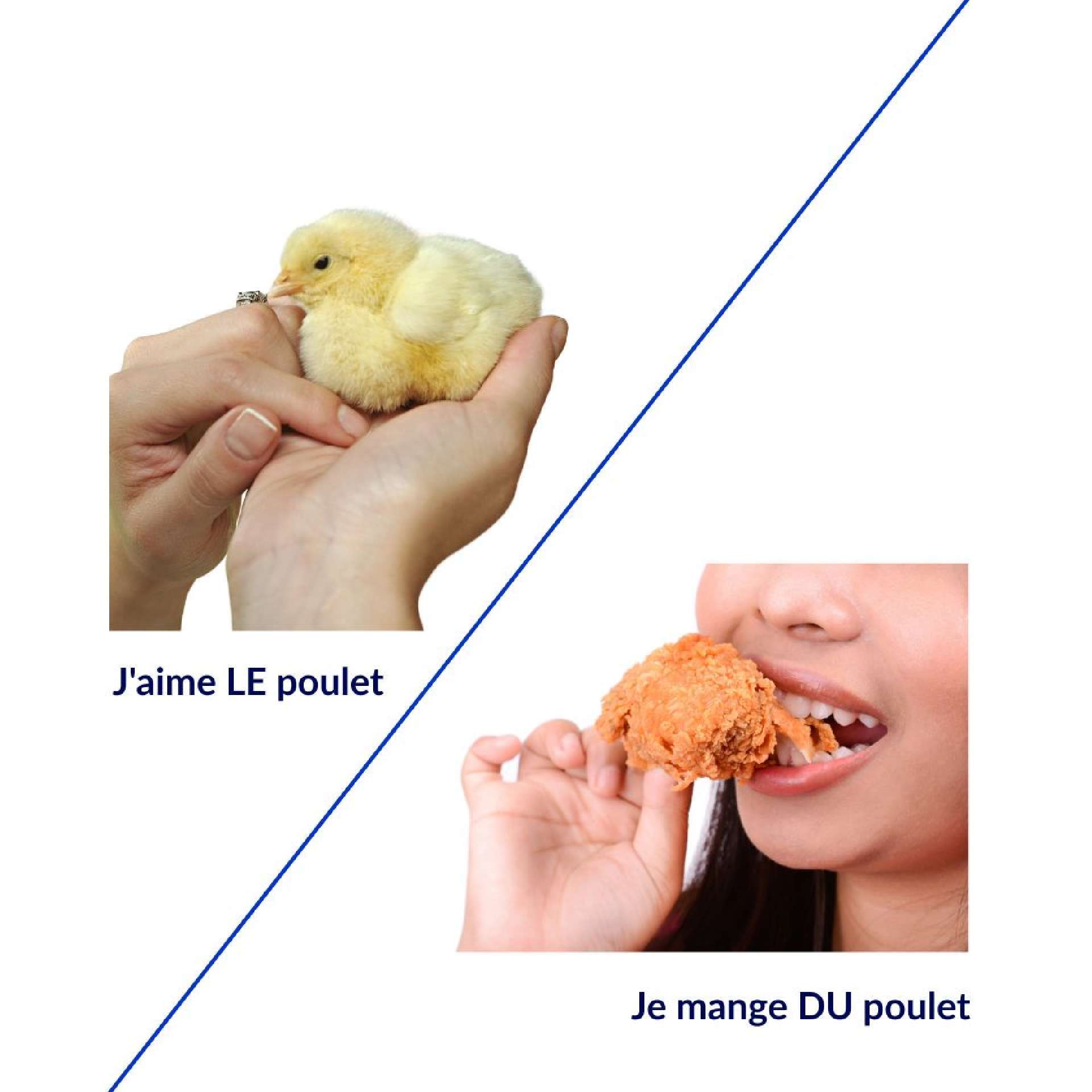
This is where many people make mistakes, even after years of study. There is a group of verbs that always require the use of the definite article (le, la, les), regardless of whether we are talking about food or abstract concepts.
These are verbs of ‘feelings’ and ‘preferences’:
- Aimer (to like/love)
- Adorer (to adore)
- Préférer (to prefer)
- Détester (to hate)
Why? Because if you like chocolate, you don’t like ‘a piece of chocolate’. You like chocolate in general, as a type, as an idea. All the chocolate in the world.
On the other hand, verbs of ‘consumption’ and ‘possession’ use partial articles because you only consume a fragment of reality:
- Manger (to eat)
- Boire (to drink)
- Avoir (to have)
- Acheter (to buy)
- Vouloir (to want)
Let’s compare this with some examples:
| Preference verb (whole) | Consumption verb (part) |
| J’aime le café. (I like coffee. (In general)). | Je bois du café. (I drink coffee. (Now, a cup)). |
| J’adore les épinards. (I love spinach). | Je mange des épinards. (I eat spinach). |
| Je déteste le poisson. (I hate fish). | Je ne mange pas de poisson. (I don’t eat fish – note the negation!). |
See the difference? ‘Liking‘ encompasses the whole phenomenon. ‘Eating‘ encompasses only a part of it.
The Trap of Negation: The Magical’ DE’
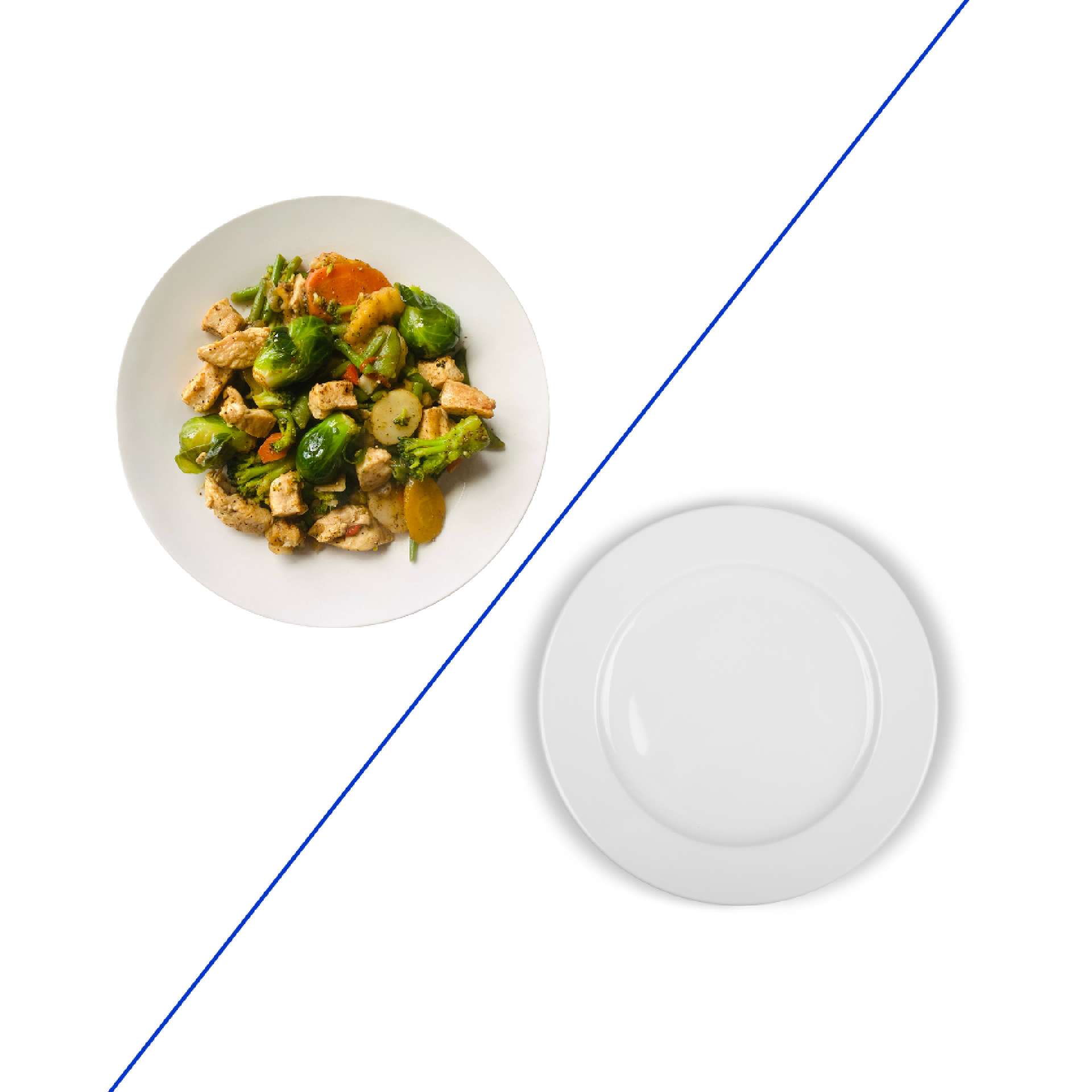
This is a rule that works like a steamroller. It crushes all the nuances of un, une, du, de la and leaves behind a flat, simple DE.
Rule: In a negative sentence (with the construction ne… pas, ne… jamais, ne… plus), indefinite and partial articles are replaced by DE alone (or d’ before a vowel).
It is because negation removes the concept of ‘quantity’. If you don’t have something, you don’t have ‘one’ or ‘a little’. “De” simply means ‘none’.
See the difference:
- Indefinite article:
J’ai une voiture. (I have a car)
Je n’ai pas de voiture. (I don’t have a car)
(Error: Je n’ai pas une voiture, unless you want to say ‘I don’t have ONE car, I have two’).
- Partitive article:
Je mange de la viande. (I eat meat)
Je ne mange pas de viande. (I don’t eat meat)
- Plural:
J’ai des amis. (I have friends)
Je n’ai pas d’amis. (I don’t have friends)
This ‘de‘ acts like a canceller. It doesn’t matter what came before. If there is pas, then de almost always jumps in.
Exception to the exception (because it’s French)
The pas de rule does not work with the verb être (to be). The verb être does not refer to possession or consumption, but to identity. Identity does not change with ‘no’. After c’est or ce sont, the article remains the same.
C’est une catastrophe. → Ce n’est pas une catastrophe. (It’s not a disaster).
C’est du vin. → Ce n’est pas du vin. (It’s not wine).
Specific quantities: When does ‘Du’ disappear?
Now that we understand that du and de la mean ‘an unspecified quantity,’ what happens when the quantity is specified?
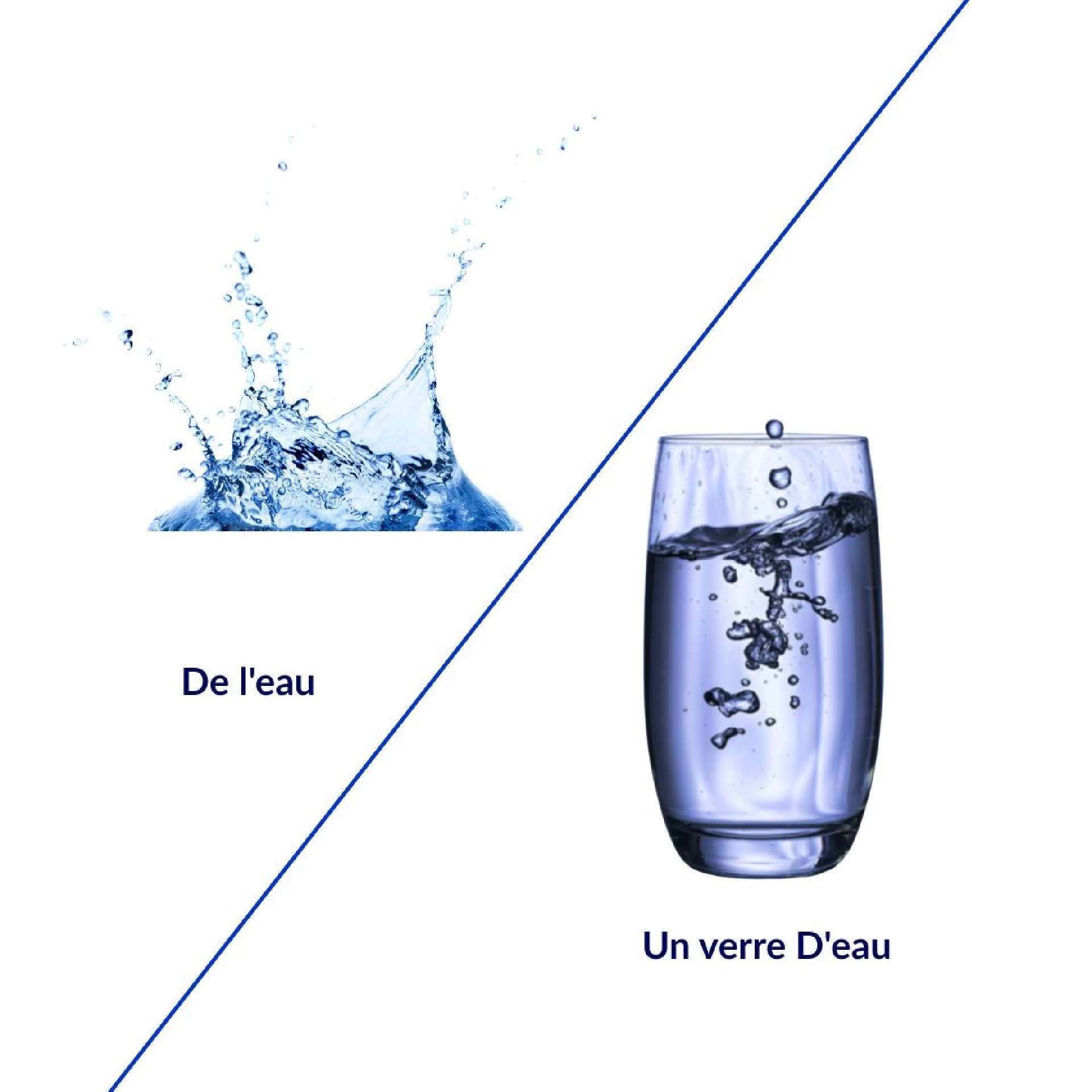
When you specify exactly how much of something there is (using weight, packaging, or an adverb), the partitive article disappears, and only DE remains.
Think of it this way: the word specifying the quantity becomes the ‘package,’ and “de” is the label ‘with contents.
It works like math:
- Indefinite: I drink water → Je bois de l’eau. (How much? We don’t know.)
- Definite: I drink a litre of water → Je bois un litre d’eau. (Specific!).
Notice: De l’ has changed to d’. Why? Because ‘litre’ has taken over the function of specifying quantity. The word specifying quantity becomes the ‘package’, and “de” is the label ‘with contents’.
Examples:
- Adverbs of quantity:
Beaucoup de travail (A lot of work).
Un peu de sucre (A little sugar).
Trop de gens (Too many people).
Assez de temps (Enough time).
- Packaging and measures:
Un kilo de pommes (A kilo of apples).
Une bouteille de vin (A bottle of wine).
Une tasse de thé (A cup of tea).
Une tranche de jambon (A slice of ham).
Note! It is incorrect to say J’ai beaucoup des amis. Correct: J’ai beaucoup d’amis. ‘Beaucoup’ is so strong that it eats up the article.
Something for dessert: Partitive articles in music and sport
For dessert, I have left some uses that do not relate to food but are key in everyday conversation.
Faire du sport (To play sport)
In French, the construction faire + sport/activity always requires a partitive article. We treat sport as a ‘mass of activity’.
Je fais du tennis. (I play tennis).
Elle fait de la natation. (She swims).
Nous faisons du ski. (We go skiing).
Jouer de la musique (To play music)
It’s more interesting with instruments. We use the verb jouer (to play) + the preposition de + the article. This gives us the forms du/de la.
Je joue du piano. (I play the piano).
Tu joues de la guitare. (You play the guitar).
Danger: If you play a team game (with a ball), you use au (à + le), not du!
Je joue au football. (Team game/ball).
Je joue du violon. (Instrument).
Your cheat sheet for remembering this
Are you starting to get confused? That’s normal. French grammar takes time to learn. Let’s put it all together into one simple decision-making system.
Ask yourself these questions:
- Can I count it? (1, 2, 3…)
YES → Use Un / Une / Des.
- Is it a mass, a liquid or an abstract concept?
YES → Use Du / De la.
- Is the sentence negative (it’s not the verb ‘to be’)?
YES → Forget the rest, use De.
- Is the quantity strictly defined (kilo, lot, bottle)?
YES → Use DE (e.g. beaucoup de pain).
- Are you using a verb of preference (aimer, adorer) or consumption (manger, boire, avoir)?
PREFERENCE: Use LE / LA / LES (e.g. J’aime le pain).
CONSUMPTION: Use DU / DE LA (e.g. Je mange du pain).
French grammar can be complicated, but it has its own logic. The key is to stop translating word-for-word from your native language and start ‘feeling’ the context. Are you eating chicken (the animal – un poulet) or chicken (the meat on your plate – du poulet)? Do you ‘have time’ (tu as du temps – an abstract concept) or ‘have a moment’ (tu as un moment – a unit of time)?
French can be mastered if you stop treating it like an enemy. And you start treating it like a logical puzzle. Mistakes are part of the process. Speak, try, make mistakes. It’s the only way to achieve fluency.