
Have you ever felt a slight twinge of uncertainty before saying a simple sentence in French, just because you weren’t sure which article to use: un or une? Le or la? Noun gender is not just a ‘grammatical addition’. It is the foundation on which the entire sentence structure is based: from the agreement of adjectives, through the forms of pronouns, to the endings of past participles.
In this article, we will not only explain the rules but also walk you through the basics, fascinating exceptions, and contemporary linguistic debates. Whether you are just starting your adventure with French or polishing your French at the C1 level, this text will equip you with the tools you need to stop guessing and start knowing.
Why does gender matter?
Masculine or feminine? (And why it’s not the same as sex)
First, we need to dispel the biggest myth that keeps many learners from learning. Grammatical gender is not the same as biological sex.
If your native or second language is English, the French system may seem shocking. In English, all nouns that do not refer to people are neuter; they are neutral (it). When entering the world of French, you suddenly have to accept that objects have a ‘gender’. This requires a complete reprogramming of how you think about the reality around you.
On the other hand, those who know German may paradoxically feel more confident. Here we have three genders (der, die, das), similar to Polish (ten, ta, to). French, as the heir to Vulgar Latin, has reduced this system to a binary one:
Masculin (masculine): represented by the articles le / un.
Féminin (feminine): represented by the articles la / une.
There is no neuter gender (although the pronouns ce or il in impersonal forms sometimes perform this function). Nouns are always ‘something’.
Biology vs. Grammar: When does gender matter?
At a basic level, the issue seems simple. In the case of living beings (humans and most animals), grammatical gender coincides with natural (biological) gender.
L’homme (man) – masculine gender.
La femme (woman) – feminine gender.
Le coq (rooster) vs La poule (hen).
Le lion (lion) vs La lionne (lioness).

This is intuitive for everyone. Problems arise when we enter the world of inanimate objects and abstract concepts. Why is le courage (courage) masculine and la jalousie (jealousy) feminine? Do the French consider courage to be a masculine trait? No, they do not.
In most cases, gender assignment is based on etymology (Latin origin). Latin neuter nouns have been absorbed mainly by the masculine gender in the course of the evolution of the French language. This is why so many words that are neuter in Polish or German end up in the masculine category in French. We have to abandon the logic we know from our native language. Comparing genders between languages is a trap, e.g.:
Sun: In Polish, ‘to’ słońce (neuter), in German, die Sonne (feminine), in French, le soleil (masculine).
Moon: In Polish, ‘ten’ księżyc (masculine); in German, der Mond (masculine); in French, la lune (feminine).
Remember: Do not try to translate the logic of your native language or another foreign language into French using a 1:1 method. French grammatical gender is an autonomous system that has its own rules.
How to recognise the gender by appearance?
For a language learner, it is impossible to memorise the gender of each word individually. The good news is that French is not chaotic. About 80-90% of nouns can be assigned to a specific gender based on their ending. Instead of learning each word individually, learn to recognise patterns.
Here is your roadmap through the jungle of endings.
Masculine nouns (Masculin)
Usually (but not always), masculine words end in a consonant or in endings that sound more ‘hard’.
-age: le courage, le garage, le fromage, le voyage, le passage, le garage, le tournage.
Exceptions are everyday words: la plage, la cage, la page, la rage, l’image, la nage.
-ment: le gouvernement, le monument, le moment, le changement, le développement. (This ending is almost 100% safe for masculine nouns).
-isme: le capitalisme, le tourisme, le réalisme, le dynamisme, le professionnalisme. (All abstract concepts with this ending are masculine).
-eau: le bateau, le château, le bureau, le réseau, le plateau,
Exceptions: la peau, l’eau
-phone / -scope: le téléphone, le microscope (words of Greek origin).
-al / -el: le journal, le potentiel, le matériel.
Feminine nouns (Féminin)
Feminine words often end in a silent -e or in endings that sound more ‘soft’.
-tion / -sion / -cion: la nation, la question, la passion, la décision, la solution, la suspicion.
Exception: le bastion.
-té / -tié: la liberté, la société, la beauté, la qualité, l’amitié.
Exception: le côté, l’été, le pâté.
-ure: la nature, la culture, la peinture, la structure, la signature.
Exception: le murmure (whisper).
-ette: la cigarette, la bicyclette, la tablette, la disquette.
Exception: le squelette
-ence / -ance: la différence, la chance, la présence, la croissance, la confiance.
Exception: le silence.

Be careful with words ending in -e. Although it is associated with the feminine gender, many of the most important abstract concepts are masculine: le problème, le système, le programme, le domaine, le modèle, le groupe, le thème. Confusing the gender in these words is one of the most common mistakes.
When a change in gender changes reality
In French, some words are spelt identically but have dramatically different meanings depending on whether we use LE or LA.
At this moment, linguistic precision becomes crucial. A mistake can completely change the meaning of your statement and lead to funny and sometimes embarrassing misunderstandings. Let’s look at some examples in context:
A. Le tour vs. La tour
Le tour (masculine) – turn, trip, trick.
C’est à mon tour de parler. (Now it’s my turn to speak.)
Nous avons fait le tour du monde. (We travelled around the world.)
La tour (feminine) – tower (building).
J’ai visité la tour Eiffel hier. (I visited the Eiffel Tower yesterday.)
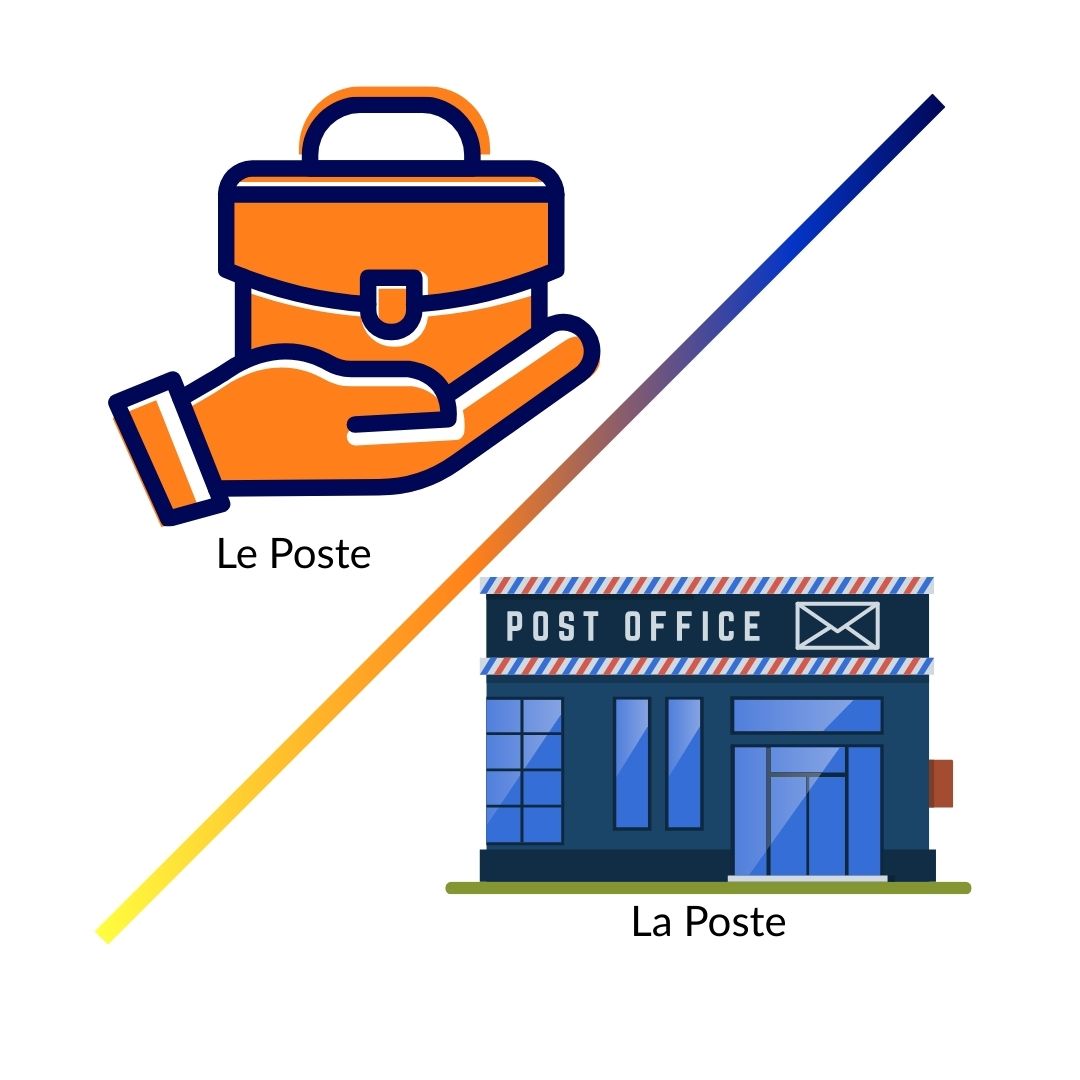
B. Le poste vs. La poste
Le poste (masculine) – job, position.
Il occupe un poste important dans cette entreprise. (He holds an important position in this company.)
La poste (feminine) – post office (institution/building).
Je dois aller à la poste pour envoyer un colis. (I have to go to the post office to send a parcel.)
C. Le livre vs. La livre
Le livre (masculine) – book.
J’ai lu un livre fascinant. (I read a fascinating book.)
La livre (feminine) – pound (currency or unit of weight).
Cela coûte vingt livres sterling. (It costs twenty pounds sterling.)
D. Le mémoire vs. La mémoire
Le mémoire (masculine) – thesis, memoir, dissertation.
Elle écrit son mémoire de master. (She is writing her master’s thesis.)
La mémoire (feminine) – memory.
J’ai une très bonne mémoire visuelle. (I have a very good visual memory.)
E. Le mode vs. La mode
Le mode (masculine) – method, mode of operation (often in IT and procedures).
Veuillez activer le mode ‘révision’ pour modifier ce contrat. (Please activate “review” mode to modify this contract.)
La mode (feminine) – fashion (clothes, trends).
Elle suit toujours la dernière mode. (She always follows the latest fashion.)
F. Le manche vs. La manche
Le manche (masculine) – handle, e.g. of a broom.
J’ai cassé le manche de mon balai. (I broke the handle of my broom.)
La manche (feminine) – sleeve.
J’ai une tache sur la manche. (I have a stain on my sleeve).
La Manche (capitalised) is the La Manche Canal.
Why is ‘Accord’ a nightmare and a necessity?

You may ask, ‘If I confuse le with la, won’t the French person understand me?’ They will understand. Context usually saves the day.
However, the problem with gender is that it infects the entire sentence. We call this phenomenon agreement (l’accord). One small mistake at the beginning of a sentence causes a domino effect.
Look at this structure:
Masculine: ‘Un nouveau client est arrivé ; il est très content.’
Feminine: ‘Une nouvelle cliente est arrivée ; elle est très contente.’
Note that the change in the gender of the noun changed:
The article (un → une).
The adjective (nouveau → nouvelle).
The past participle (arrivé → arrivée, often inaudible in speech, but crucial in email!).
The pronoun (il → elle).
Predicate adjective (content → contente).
An incorrect article is just the tip of the iceberg. That’s why mastering gender is the key to sounding professional and elegant. In professional communication, especially written communication (reports, emails), errors in agreement are perceived as a lack of care.
How to learn this without going mad?
Finally, I have a few proven mnemonic techniques for you, which I use with my clients during coaching sessions. Forget about mechanically memorising lists of words.
1. Never learn a ‘bare’ word
It’s the most important rule. If you write the word ‘table’ in your notebook, don’t write Bureau. Write LE bureau. Or even better: UN bureau. Why un/une and not le/la? Because in pronunciation, the difference between le and la sometimes blurs before a vowel (it changes to l’), e.g. l’école. You don’t know if it’s le or la. But une école is clearly audible! Always learn a word inseparably linked to its indefinite article.
Your brain must encode the article as an integral part of the word, like the first syllable.
2. Colour Visualisation Method
If you are a visual learner, use colour coding in your notes.
Write all masculine words in blue (or another colour that you associate with masculinity).
Write all feminine words in pink (or another colour that you associate with femininity).
Over time, your brain will begin to ‘see’ the colour of the word, even when you don’t write it down.
3. The ‘Sexist Associations’ Technique (Mnemonics)
Create absurd stories in your head. If you have trouble remembering that le mur (wall) is masculine, imagine that wall with a moustache, smoking a cigar. If la voiture (car) does not want to enter your head as a feminine noun, imagine this car in high heels and with painted lips. The more absurd the association, the easier it is to remember.
4. Analysis of the environment
Cover your house with Post-it notes. Stick them on the mirror, le miroir, on the door, la porte. You will look at them for a week until they become second nature to you.
Gender is not an obstacle; it is precision
Noun gender in French is a challenge, not an insurmountable obstacle.
Learning French noun gender is a marathon, not a sprint. It is a process that requires moving from frustration (‘why doesn’t this make sense?’) to analytical observation (‘I see a pattern here’). Mistakes will happen. Even native speakers sometimes have doubts (that’s why dictionaries were invented!). The key is not perfection from day one, but making mistakes, paying attention to endings, constantly exposing yourself to the language, and accepting the fact that grammatical logic does not always go hand in hand with our everyday logic. Every mistake is a step towards fluency if you learn from it.