Imagine this scene: you are sitting in a business meeting, presenting a project in English. Your analysis is flawless, your strategy visionary. You have thoroughly prepared, and your knowledge of foreign-language grammar is at the C1 level. However, the moment you start speaking, you feel that familiar tension. You hear your ‘hard’ accent and suddenly feel that your professional aura is fading a little.
Or another situation: you are on holiday, sitting in a charming café in Lisbon or Paris. You order a coffee, trying to imitate the language’s melody, but the waiter immediately responds in English. Frustrating? Definitely. But is it your fault? Absolutely not.
An accent in a foreign language is not a sign of laziness or lack of talent. It is a fascinating side effect of how our brain learned to understand the world of sounds in childhood. And it may seem like an obstacle, but it is actually proof of something extraordinary: your ability to use more than one communication system.
Today, I will take you on a journey through neurology, linguistics, and psychology to answer the question: Why do adults have accents in foreign languages? And more importantly, is it even a problem?
The biology of hearing: Why is your brain ‘deaf’?
Before we discuss the speech apparatus, we need to look inside the skull. The truth about accents begins in the ears.
As infants, we are born as ‘citizens of the world‘ – our brains can distinguish every sound that occurs in any language on the globe. However, around 10-12 months of age, a drastic selection takes place.
To conserve energy, the brain begins to ignore sounds that do not occur in its immediate environment. If certain sound distinctions do not exist in your native language, your brain stops registering them.
The ‘Magnetism’ Mechanism
Research has proven that our native language creates a kind of ‘magnetic map’. New sounds that we hear as adults are ‘drawn in’ by the closest sounds known from childhood. For example:
If you are Polish, your brain hears the English /æ/ (in the word cat) and /e/ (in the word get) and often classifies them both as the Polish ‘e’.
If your language is Japanese, your brain may not distinguish between /l/ and /r/ because these sounds are too close together on your ‘magnetic map’.
To a Polish speaker, the English words sheep and ship sound almost identical.
To an English or German speaker, the Polish’ sz’, ‘cz’ and “ś”, ‘ć’ are often the same sound.
Adults have an accent not because they cannot repeat a sound, but because their brains do not physically register the difference. You cannot pronounce something that your brain cannot hear. So the first step to improving your pronunciation is to unblock your hearing, not to practise your tongue.
Anatomy of speech: The tongue as an instrument
Speaking is a sport that requires the coordination of dozens of muscles: the tongue, lips, teeth, palate, larynx and diaphragm. Throughout your life, you have trained these muscles to move in a specific way. When you learn a new language as an adult, you ask your muscles to perform acrobatics they have never done before. That is why your speech apparatus subconsciously takes shortcuts. It means: choosing movements it already knows. An accent is nothing more than these small, subconscious muscle movements that try to return to familiar positions. Your accent is simply a matter of muscle memory.
Prosody: Music that betrays you the fastest
Did you know that you can pronounce words perfectly and still have a strong accent? It’s all because of prosody. Prosody refers to all elements of communication related to sound that cannot be classified as phonological phenomena, i.e., sounds. We distinguish between: accent, speech tempo and rhythm, the use of pauses, duration and pitch, and the associated intonation.
Machine-gun languages versus Morse code languages
Linguists divide languages into two main rhythmic groups:
Syllable-timed (isochronous): e.g. Polish, French, Spanish. Here, each syllable lasts approximately the same amount of time. It sounds like a series of shots from a machine gun (ta-ta-ta-ta).
Stress-timed (accentometric): e.g. English, German, Russian, Portuguese. Here, time flows from one accent to another. Unstressed syllables are ‘eaten up’, reduced and shortened to a minimum (the famous schwa sound /ə/).
Every language has its own rhythm.
Polish is steady, like a drum (each syllable lasts about the same amount of time).
English is like jazz: some syllables are very long, while others almost disappear.
French builds tension by usually emphasising the end of a phrase.
Transferring the melody from one language to another is the most common cause of foreign-sounding speech. It’s like trying to dance a waltz to hip-hop music. It’s possible, but everyone will notice that something is wrong.
International Perspective: How do languages ‘betray’ us?
Each nationality has its own specific accent profile, which results from interference from the native language. Let’s look at a few interesting cases:
Germans: They often have a problem with so-called final devoicing. In German (and Polish!), consonants at the end of words lose their voicing. That’s why dog becomes dok, and bad sounds like bat.
French: Their most significant challenge is h-aspiration (they often omit it, saying ‘ouse instead of house) and shifting the accent to the last syllable, which in English or German completely changes the melody of the sentence.
Portuguese (from Portugal): They often sound to Poles… like Russians or Poles. This is because European Portuguese has very strong vowel reduction and a large number of sibilant sounds, which create the illusion of a Slavic sound.
Anglo-Saxons: When learning Romance or Slavic languages, their biggest problem is ‘diphthongisation‘. They tend to add a small ‘j’ or ‘u’ at the end of pure vowels (e.g. they pronounce the Polish “to” as ‘tou’).
The trap of ‘native-speakerism’
As a language and communication coach, I must make one thing very clear: striving to sound exactly like a ‘native speaker’ in today’s business world is often a waste of your most valuable resource – time.
In linguistics, there is a concept called native-speakerism. It is an ideology that claims that native speakers are the only legitimate models of pronunciation. This is a harmful myth, especially in the era of Global English. Today, many more people speak English as a second language than native speakers. The standard is no longer BBC English, but ‘International Business English‘.
Research indicates that learners are their own harshest critics. Native speakers usually admire our fluency and rarely notice our accent as long as we are understandable. Ridiculing our own ‘sound’ is a form of self-sabotage that lowers our confidence at key moments in negotiations. Your accent is not a barrier – it is a testament to your multilingualism.
Can you ‘grow out’ of your accent? The myth of the critical age
‘I’m too old to sound good’ is the most common phrase I hear. Is there a ‘critical age’? Yes, a child’s brain is like a sponge until the age of 7. Still, the neuroplasticity of the adult brain is greatly underestimated.
Recent studies of adults who learned a language at the age of 30, 40, or 50 show that many achieve a pronunciation level indistinguishable from that of native speakers. What do they have in common? Not genes, but three factors:
Integrative motivation: The desire to be part of a new culture, not just a ‘user’ of the language.
Conscious phonetic training: Understanding where the tongue is physically located for a specific sound (e.g., the difference between the Polish ‘ż’ and the English ‘j’).
Mindfulness: Listening to yourself actively and making self-corrections in real time.
Your new strategy: Comprehensibility over perfection
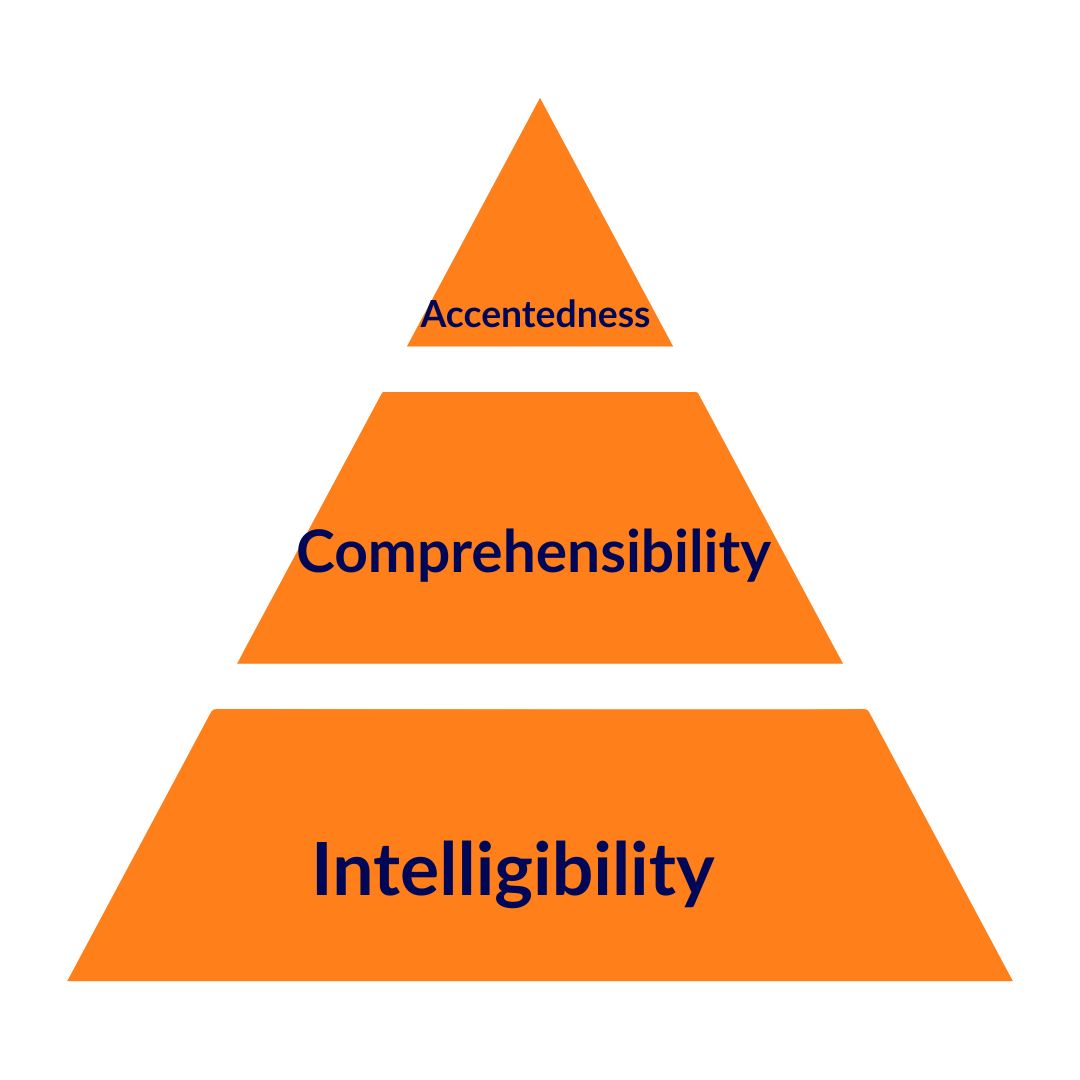
Instead of asking, ‘What can I do to remove my accent?’, start asking, ‘How can I be more understandable?’ We distinguish between three concepts:
Intelligibility: Are your words physically recognisable? When you say ‘desk‘, does someone hear ‘disk‘? This is the foundation.
Comprehensibility: How much energy does the listener have to expend to understand you? If your accent is strong but your rhythm and intonation are correct, your comprehensibility is high.
Accentedness: This is a purely subjective impression of how ‘foreign’ you sound.
Shocking fact: You can have a strong accent (high accentedness) and still be fully understandable and respected (high intelligibility). In business, it is the latter that builds your authority. Your job is not to sound like a Hollywood actor, but to eliminate those errors that actually block the transmission of information.
Is an accent a mistake?
As high-class specialists, we must ask ourselves: what is our goal? Is it to be a ‘spy’ whom no one will recognise, or to be an effective communicator?
In the modern world, the concept of ‘native speakerism’ is becoming obsolete. What matters is intelligibility. Research shows that a slight foreign accent can even be an asset. It is perceived as proof of:
Higher education and competence (you know many languages).
Rich cultural experience.
Courage and determination.
An accent becomes a mistake only when it hinders the understanding of the message. If your interlocutor has to ask you to repeat a sentence three times, it is not an aesthetic problem – it is an operational problem that costs time and money.
Accent as part of your personal brand
Now something on the borderline between psychology and provocation: your accent is not a mistake. It is proof of your intelligence. It is proof of three extremely important things in business:
Courage: You had the courage to step outside your comfort zone and operate in a foreign environment.
Cognitive complexity: Your brain operates on multiple symbolic systems – you are naturally better at problem solving and creative thinking.
Unique identity: In a world full of copies, your ‘European’ or ‘Polish’ sound is a sign of authenticity.
People do not trust perfect machines. They trust consistent leaders. If your knowledge is expert and your voice carries the story of your origins, you build deeper trust than someone who forces an artificial accent to sound like a native speaker.
In a business and international environment, an accent signals that ‘this person is fluent in more than one operating system.’ It is a testament to your journey, your education, and your courage to venture beyond your own backyard. Many opinion leaders have turned their accents into a unique personal brand.
Is it possible to completely get rid of an accent?
Many people ask, ‘When will I finally stop sounding like a foreigner?‘ Science suggests that while perfection is an ambitious goal, the path to it depends on a combination of many factors. Research indicates that a unique mix of influences pronunciation quality:
Individual phonetic abilities (some of us simply have a ‘better ear’),
Motivation (how much we want to identify with the new culture),
Amount of exposure (immersion in the language),
Formal instruction (consciously learning phonetics helps more than just listening).
How to ‘smooth out’ your speech without losing yourself?
If you want to work on your pronunciation, don’t do it out of embarrassment. Do it for your listener’s comfort. Here are the specific steps:
Shadowing: Choose a leader whose way of speaking suits you. Listen to them through headphones and repeat after them with a 1-2 second delay. Don’t focus on the words, but on the ‘music’ – where do they pause, where do they raise their voice?
IPA (International Phonetic Alphabet) analysis: Stop guessing how to pronounce words. Learn the basic IPA symbols for your target language. When you see the symbol /θ/ (English th) in the dictionary, your brain will receive a specific instruction: ‘put your tongue between your teeth’.
Record and diagnose: Record your speech. Don’t judge yourself harshly. Ask yourself, ‘At what point would I have difficulty understanding myself?’ Usually, it’s not the sounds that are to blame, but the pace.
Manage your pauses: Leaders with accents often speak too quickly to ‘hide’ their mistakes. The effect is the opposite. Slow down. Pauses are your most powerful rhetorical tool. They give the listener time to process your rhythm.
Your unique sound
An accent is information. It is a record of your journey, your education and your courage. You don’t have to remove it to be heard and respected. You can consciously ‘smooth out’ the elements that actually hinder communication, while keeping your sound as proof of your uniqueness.
For the next week, every time you feel a hint of embarrassment when speaking a foreign language, think about your brain. It is doing a tremendous job for you, connecting cultures and markets. It deserves your admiration, not your criticism.
Learning a language is a journey, and accent is an integral part of it. The most important thing in communication is to be understood, not to be a copy of a native speaker.
Bibliography:
Lan, Y., Xie, T., & Lee, A. (2023). Portraying accent stereotyping by second language speakers.
Kong-Insam, M. (2021). VOT as a phonetic cue of foreign accentedness – a case study approach.
Lewendon, J., Foltz, A., & Thierry, G. (2020). Electrophysiological Differentiation of the Effects of Stress and Accent. Brain Sciences.
Kralova, Z., & Krajcovic, M. (2009). Variance in a second language pronunciation quality. Communications.
Ghazi-Saidi, L., Dash, T., & Ansaldo, A. I. (2015). How native-like can you possibly get: fMRI evidence for processing accent. Frontiers in Human Neuroscience.
Cheng, B., & Zhang, Y. (2015). Syllable Structure Universals and Native Language Interference… Frontiers in Psychology.
Archibald, J. A. (2021). Speaking and Hearing with an Accent. Frontiers for Young Minds.
Bustos, J., Vignolo, F., & Vyhmeister, G. (2023). A study on auditory perception of tense and lax vowels…
Hopp, H., & Schmid, M. S. (2013). Perceived foreign accent in first language attrition and second language acquisition. Applied Psycholinguistics.
We use cookies to personalise content and ads, to provide social media features and to analyse our traffic. We also share information about your use of our site with our social media, advertising and analytics partners. View more
Cookies settings
Accept
Decline
Privacy & Cookie policy
Privacy & Cookies policy
Cookies list
Cookie name
Active
Hello!If you come here, it is a sure sign that you value your privacy. I understand this perfectly, so I will give you a document where you will find the rules for processing personal data and using cookies and other tracking technologies in one place.Formal information at the beginning: the administrator of your personal data is me, i.e. Lingua Impact Agnieszka Kujawska, 684 rue du Chevalleret Z.A. de Moru, 60700 Pontpoint, France.I process your personal data primarily for the purposes related to your use of my website and social media. These include newsletter support, comment service, social media support, message exchange, analysis, statistics, marketing, etc.I process your personal data for the period necessary to implement individual purposes. You have the right to access, rectify, delete or limit the processing of your personal data, object to the processing, and data portability.Detailed information on the principles of processing your personal data can be found later in the Privacy Policy.If you have any doubts related to the Privacy Policy, you can contact me at any time by sending a message to contact@linguaimpact.eu.
1: Who is the administrator of your personal data?
The administrator of your personal data is me, i.e. Lingua Impact Agnieszka Kujawska, 684 rue du Chevalleret Z.A. de Moru, 60700 Pontpoint, France.This Privacy Policy applies to the website www.lingua-impact.eu.In the scope of my social media profiles, in accordance with the case law of the Court of Justice of the European Union, I am the data controller with the provider of social networks in which I have profiles. Details on the processing of personal data by individual providers of social networks can be found here:
2: Who can you contact regarding the processing of your personal data?
As part of the implementation of personal data protection in my office, I decided not to appoint a personal data protection officer due to the fact that it is not obligatory in my situation. In matters related to the protection of personal data and broadly understood privacy, you can contact us at contact@linguaimpact.eu. In the field of social media, you can additionally contact the administrators of social networks where I run my profiles directly.
3: For what purposes do I process personal data?
There is more than one of these goals. Below is a list of them, along with a more detailed overview. Appropriate legal bases for processing have also been assigned to specific purposes:
Purpose of processing
Discussion of the purpose of processing
Legal basis
newsletter handling
When subscribing to the newsletter, you must provide the data necessary to receive it specified in the subscription form.
Providing data is a prerequisite for receiving the newsletter.
In addition, the system used to handle the newsletter saves your IP number that you used when subscribing to the newsletter, determines your approximate location, the e-mail client you use to handle e-mail and tracks your actions taken in connection with the messages sent to you. Messages. Therefore, I also have information about the messages you opened, the messages in which you clicked on links, etc.
In the mailing system, we may also define, based on various criteria related to your activity, interests or other preferences, specific groups or segments of newsletter recipients that affect what kind of newsletters you receive.
The data provided by you in connection with the subscription to the newsletter is used to operate the newsletter, which is my legally justified interest, which in this case, is the implementation of marketing objectives.
Regarding the processing of information that does not come from you and has been collected automatically by the mailing system, we rely in this respect on our legitimate interest in analysing the behaviour of newsletter subscribers in order to optimise mailing activities.
You can unsubscribe from the newsletter anytime by clicking on the dedicated link in each message sent as part of the newsletter or by simply contacting me.
Unsubscribing from the newsletter does not lead to deleting your data from the mailing system. The data goes to the archive for the purpose of possible determination, investigation or defence of claims related to the newsletter, as well as to ensure the possibility of demonstrating that the newsletter activities were carried out in accordance with the law.
Regulation (EU) 2016/679 on the protection of individuals with regard to the processing of personal data and on the free movement of such data
comment support
When adding a comment on my website, you must provide the data necessary to publish the comment specified in the form intended for issuing a comment/opinion.
Providing data is a condition for publishing a comment.
In addition, the comment system saves your IP number that you used by submitting a comment.
An external provider can operate the comment system. In such a situation, the use of the system is subject to the external supplier's regulations and privacy policy. Detailed information about third-party tool providers can be found in the section dedicated to the tools I use.
The data is processed in order to publish a comment, which is my legitimate interest.
The comment you have added, along with your data published as part of the settings, will be visible on the page. You can modify or delete a comment at any time. The deleted comment, together with your data, goes to the archive for the purpose of possible establishment, investigation or defence of claims related to the comment.
Regulation (EU) 2016/679 on the protection of individuals with regard to the processing of personal data and on the free movement of such data
contact and handling of correspondence
By contacting me via available means of communication, e.g. e-mail, social messengers, chats, etc., you naturally provide your personal data contained in the content of the correspondence.
Providing data is a prerequisite for establishing contact.
In addition, the communication system records your IP address, which you use to send a message.
The communication system (e.g. chat, messenger) can be operated by an external provider. In such a situation, the use of the system is subject to the external supplier's regulations and privacy policy.
Detailed information about third-party tool providers can be found in the section dedicated to the tools I use.
The data is processed for the purpose of communication, which is my legitimate interest. Once the communication is complete, the data goes to the archive for the purposes of possible establishment, pursuit or defence of claims related to the conducted communication.
Regulation (EU) 2016/679 on the protection of individuals with regard to the processing of personal data and on the free movement of such data
creating an archive
For the purposes of my activity, I can create archives in digital form. The archives contain personal data that I have processed in connection with you, and their scope may vary depending on what data I have received and what scope of data is justified from an archival point of view. In this case, I rely on our legitimate interest in organising and organising personal data carriers.
Regulation (EU) 2016/679 on the protection of individuals with regard to the processing of personal data and on the free movement of such data
defence, establishment or redress
Using my website may give rise to certain claims on your or my part in the future. Therefore, I am entitled to process personal data to defend, establish or pursue claims. As part of this purpose, I may process any personal data that relates to a given claim; therefore, their scope may vary depending on what the claim relates to. In this case, I rely on my legitimate interest in protecting my interests.
Regulation (EU) 2016/679 on the protection of individuals with regard to the processing of personal data and on the free movement of such data
creating ad audience groups
Your e-mail address stored in my database may be sent to a specific advertising system (e.g. Facebook Ads, LinkedIn Ads) to create a group of advertising recipients using this e-mail address.
When using this feature, the e-mail address is hashed before being sent to Facebook to form an audience.
The e-mail address will be used in the matching process carried out by the respective advertising system.
Facebook does not share the e-mail address with third parties or other advertisers and deletes the e-mail address as soon as the matching process is completed.
Facebook has implemented processes and procedures to ensure the confidentiality and security of the e-mail address sent to it and the set of Facebook user identifiers that create a group of recipients created using the e-mail address, among other things, through the use of technical and physical security.
Creating a group of advertising recipients using your e-mail address is my legitimate interest, which in this case, is implementing my marketing goals.
Regulation (EU) 2016/679 on the protection of individuals with regard to the processing of personal data and on the free movement of such data
handling social media
Suppose you follow our profiles on social networks or interact with the content we publish on social media. In that case, we naturally see your data publicly available on your social profile.
We process this data only within a given social networking site and only to operate a given social networking site, which is our legitimate interest referred to in art.
If you contact me via a private message, you naturally provide me with your personal data contained in the content of the correspondence, in particular the image and the name and surname. In this case, your data is processed in order to contact you, and the basis for processing is my legitimate interest.
It may happen that I will be the party initiating contact with you via social media in order to offer cooperation; then, your data will be processed in order to search for potential contractors and offer and establish cooperation, which is my legitimate interest.
Messages sent to me via social media are subject to automatic archiving by means of the tools available within individual social networks. They are available to me until you delete them. You can view all messages listed with me in the private messages tab.
Your use of social networks is subject to the regulations and privacy policies of the administrators of these websites, and these administrators provide you with services by electronic means, entirely independently and independently of us.
Regulation (EU) 2016/679 on the protection of individuals with regard to the processing of personal data and on the free movement of such data
analysis and statistics using only Anonymous Information
I conduct analytical and statistical activities using tools provided by external suppliers. As part of the analytical tools, we only have access to Anonymous Information. The processing of Anonymous Information is based on a legitimate interest, which consists in creating, reviewing and analysing statistics related to the activity of users on the website in order to draw conclusions allowing for the subsequent optimization of my activities.
From the level of Google Analytics and Facebook tools, we only have access to a set of statistics and information not assigned to specific people.
Detailed information about third-party tool providers can be found in the section dedicated to the tools I use.
Regulation (EU) 2016/679 on the protection of individuals with regard to the processing of personal data and on the free movement of such data
own marketing using only Anonymous Information
I conduct marketing activities using tools provided by external suppliers. We only have access to Anonymous Information as part of the analytical tools. I base the processing of Anonymous Information on a legitimate interest, which consists in conducting marketing activities based on Anonymous Information and targeting advertisements within external systems based on Anonymous Information, for the purposes of marketing my own products and services. From the level of Google Analytics and Facebook tools, we only have access to a set of statistics and information not assigned to specific people.
Detailed information about third-party tool providers can be found in the section dedicated to the tools I use.
Regulation (EU) 2016/679 on the protection of individuals with regard to the processing of personal data and on the free movement of such data
provision of additional functions using only Anonymous Information
On my website, I can embed video or audio players, social widgets, comment modules, chat, newsletter forms or other tools provided by third parties. All these tools process Anonymous Information. The processing of Anonymous Information is based on a legitimate interest, which in this case consists in ensuring the possibility of using additional functions on the website. From the level of tools, I have no insight into others' information; in addition, I do not need this information for anything – Anonymous Information is processed only so that additional functions can work. Detailed information about third-party tool providers can be found in the section dedicated to the tools I use.
Regulation (EU) 2016/679 on the protection of individuals with regard to the processing of personal data and on the free movement of such data
obligations related to the protection of personal data
As a personal data administrator, I am obliged to implement obligations related to protecting personal data. Therefore, I may process your personal data insofar as it is necessary to perform these obligations (e.g. in the case of processing your request regarding your personal data). The scope of data depends on what data is needed to fulfil the obligation and prove compliance with the protection of personal data. In addition, in this case,
I also rely on my legitimate interest, which consists in securing the data necessary to demonstrate accountability.
Regulation (EU) 2016/679 on the protection of individuals with regard to the processing of personal data and on the free movement of such data
4: What information do I have about you?
The scope of the processed data is described in relation to each processing purpose. Information in this regard can be found above, in point 3 of the Privacy Policy. The data includes information such as:
first name,
e-mail address,
IP address,
data collected in the mailing system,
data related to the added comment,
information visible in social media profiles,
information contained in correspondence,
Anonymous Information.
5: What is "Anonymous Information"?
Moreover, we use tools that collect a lot of information about you related to the use of our website. It concerns, in particular, the following information:
information about the operating system and web browser,
subpages viewed,
time spent on the page,
transitions between individual subpages,
clicks on individual links,
Mouse movements
scrolling the page,
the source from which you go to the site,
the age range you are in,
YOUR Gender
Your approximate location is limited to the town.
Your interests are based on your online activity.
video recordings of your sessions on my pages,
heat maps illustrating your behaviour on my pages.
This information is referred to in this Privacy Policy as "Anonymous Information".Anonymous information by itself is not, in our opinion, personal information, as it does not allow us to identify you, and we do not match it with the typical personal information we collect about you. Nevertheless, taking into account the rigorous jurisprudence of the Court of Justice of the European Union and the divided opinions among lawyers, as a precautionary measure in the event that Anonymous Information is assigned the nature of personal data, we have also included detailed explanations in this privacy policy regarding the processing of this information.We are unable to provide you with access to Anonymous Information about you, as we cannot assign any of the Anonymous Information to any specific user. From the level of Google Analytics and Facebook tools, we only have access to a set of statistics and information not assigned to specific people.The processing of Anonymous Information allows you to use the functionalities available on the website. In addition, Anonymous Information is used for analytical, statistical, and marketing purposes, such as setting and targeting advertisements.Anonymous information is also processed by tool providers on the basis of their regulations and privacy policies. Anonymous Information is also used by the providers of individual tools to provide and improve services, manage them, develop new services, measure the effectiveness of advertisements, protect against fraud and abuse, as well as personalise the content and advertisements displayed on individual websites, sites and applications. Detailed information on this can be found in the section dedicated to the tools we use.
6: Where did I get your personal data from?
In most cases, you pass them on to us yourself. For example, this happens when you subscribe to the newsletter, contact via e-mail or chat, and use the functionalities available on the website or external services (e.g. social networks).In addition, some information about you may be automatically collected by the tools I use: Detailed information about third-party tool providers can be found in the section dedicated to the tools I use.
7: Is the data safe?
I care about the safety of your personal information. We have analysed the risks associated with individual data processing processes and then implemented appropriate security and personal data protection measures. I monitor the condition of the technical infrastructure on an ongoing basis, train staff, observe the procedures applied, and introduce necessary improvements.
8: How long will I keep my personal data?
We process your personal data for as long as it is justified within a given purpose of personal data processing; therefore, the processing periods vary depending on the purpose. Please note that the termination of the processing of your data for one purpose does not necessarily lead to the complete deletion or destruction of your personal data because the same set of data may be processed for another purpose for the period indicated for it. Complete deletion or destruction of data takes place when I have completed all purposes and, in other cases, indicated in Regulation (EU) 2016/679 on the protection of natural persons with regard to the processing of personal data and on the free movement of such data.Below you will find a description of the processing periods:
Newsletter – data related to the newsletter will be processed for the duration of your use of the newsletter;
Comments- data related to the posting of a comment will be processed until you delete the comment;
Contact and handling of correspondence – data related to the handling of correspondence will be processed for the duration of the contact between us;
Archive – data related to the archive will be processed until the usefulness of the information contained in the archive expires;
Establishing, pursuing and defending claims – data related to claims will be processed until the claims are time-barred, whereby the period of limitation of claims may vary in the light of applicable law;
Audience groups – data related to audiences will be processed until it becomes unusable or you effectively raise an objection;
Social media – in principle, I have no influence on the period of storage of your personal data in social media. They are available on Facebook, Instagram, YouTube or LinkedIN on the basis of the regulations and privacy policies of these services. I am not able to delete your data from Facebook, Instagram, YouTube or LinkedIN – only you can do it;
Analysis and statistics – data related to analytics and statistics will be processed until they expire or you effectively object;
Self-marketing – data related to self-marketing will be processed until it ceases to be useful or you effectively raise an objection;
Additional tools – data related to additional tools will be processed until they expire or you effectively raise an objection;
Obligations related to the protection of personal data – data related to the protection of personal data will be processed until its expiration, effective objection by you or expiry of the limitation period of my liability as a personal data administrator.
If I process your personal data on the basis of your consent, you can withdraw such consent at any time: either by your action or by contacting me at the contact details provided. Withdrawal of consent does not affect the lawfulness of processing carried out on the basis of consent before its withdrawal.
9: Who are the recipients of personal data?
We risk saying that modern business is not able to do without services provided by third parties. I also use such services. Some of these services are related to the processing of your personal data. External service providers who are involved in the processing of your personal data are:
hosting provider – for the purpose of storing data on the server;
mailing system provider – for the purposes of using the mailing system;
chat provider – for the purpose of contact via chat;
supplier of the pop-up display system – for the purpose of displaying pop-ups;
provider of a tool for managing landing pages – for the purpose of collecting data via landing pages;
a cloud computing provider – for the use of cloud solutions;
accounting office – for the purposes of using accounting services;
law firm – for the purposes of providing legal services to me;
technical service – for the purposes of carrying out technical works related to those areas in which data are processed;
other subcontractors, in particular IT solution providers – for the purposes of cooperation with various subcontractors who may have access to your personal data, if they provide services to the extent related to such access.
If necessary, your data may be made available to a legal advisor or attorney bound by professional secrecy. The need may arise from the need to use legal assistance that requires access to your personal data.In addition, if necessary, your personal data may be made available to entities, bodies or institutions authorised to obtain access to data on the basis of legal provisions, such as the police, security services, courts, and public prosecutor's offices.Moreover, when it comes to Anonymous Information, the providers of tools or plugins that collect Anonymous Information have access to it. The providers of these tools are independent administrators of the data collected in them and may share this data on the terms specified by them in their own regulations and privacy policies, over which I have no influence.
10: Do I transfer data to third countries or international organizations?
Yes, part of the processing of your personal data may involve their transfer to third countries.I transfer your personal data to third countries in connection with the use of tools using resources located in third countries, in particular in the USA. The providers of these tools guarantee an adequate level of protection of personal data through appropriate compliance mechanisms provided for by Regulation (EU) 2016/679 on the protection of natural persons with regard to the processing of personal data and on the free movement of such data, in particular through the use of standard contractual clauses.Currently, your personal data is transferred to third countries in connection with the use of the following solutions:
Type of solution
Solution provider
Third country
E-mail
Google
USA
Data Backup
Google
USA
In addition, Anonymous Information collected in connection with the use of the tools indicated in the Annex to this Privacy Policy may be transferred to third countries, in particular the USA.
11: Do I use profiling?
We do not make decisions for you based solely on automated processing, including profiling, which would have legal effects on you or similarly significantly affect you. Yes, we use tools that can take specific actions depending on the information collected as part of the tracking mechanisms. However, we believe that these actions do not have a significant impact on you because they do not differentiate your situation as a customer, do not affect the terms of the contract, which you can conclude with us, etc.By using certain tools, we can, for example, direct personalised advertisements to you based on your previous actions taken on the website or suggest products that may be of interest to you. I am talking about so-called behavioural advertising. We encourage you to learn more about behavioural advertising, in particular regarding privacy issues. Detailed information, along with the ability to manage your behavioural advertising settings, can be found here.
12: What are your rights?
Regulation (EU) 2016/679 on the protection of natural persons with regard to the processing of personal data and on the free movement of such data grants you the following potential rights in relation to the processing of your personal data:
the right to access your data and receive a copy of it
the right to rectify (correct) your data
the right to delete data (if, in your opinion, there are no grounds for me to process your data, you can request that I delete it),
the right to limit data processing (you can request that we limit the processing of data only to their storage or performance of activities agreed with you if, in your opinion, we have incorrect data or we process it unjustifiably),
the right to object to the processing of data (you have the right to object to the processing of data on the basis of a legitimate interest; you should indicate a specific situation that, in your opinion, justifies the termination of the processing covered by the objection; we will stop processing your data for these purposes unless we prove that the grounds for data processing by us override your rights or that your data is necessary for us to establish, assert or defend claims),
the right to transfer data (you have the right to receive from us, in a structured, commonly used, machine-readable format, personal data that you provided to us on the basis of a contract or your consent; you can commission us to send this data directly to another entity),
the right to withdraw consent to the processing of personal data if you have previously given such consent,
the right to lodge a complaint with the supervisory body (if you find that we are processing data unlawfully, you can file a complaint with the President of the Office for Personal Data Protection or another competent supervisory authority).
I encourage you to familiarise yourself with the provisions describing the rules related to the implementation of the above-mentioned rights. For our part, we consider it necessary to explain to you that the above-mentioned rights are not absolute, and you will not be entitled to all activities of processing your personal data.I emphasise that you always have one of the rights indicated above; if you consider that when processing your personal data, we have committed a violation of the provisions on the protection of personal data, you have the opportunity to lodge a complaint with the supervisory authority.
13: Do I use cookies and what are they exactly?
Our website, like almost all other websites, uses cookies.Cookies are small text information stored on your end device (e.g. computer, tablet, smartphone) that can be read by our ICT system (own cookies) or ICT systems of third parties (third-party cookies). In cookies, specific information can be saved and stored, which ICT systems can then access for specific purposes.Some of the cookies we use are deleted after the end of the web browser session, i.e. after closing it (so-called session cookies). Other cookies are stored on your device and enable us to recognize your browser the next time you access the site (permanent cookies).If you want to learn more about cookies, you can see, for example, this material.
14: On what basis do I use cookies?
We use cookies on the basis of your consent, except when cookies are necessary for the proper provision of electronic services to you.Cookies that are not necessary for the proper provision of electronic services remain blocked until you consent to the use of cookies. During your first visit to the website, we display a message asking for your consent along with the possibility of managing cookies, i.e. deciding which cookies you agree to and which you want to block.
15: Can you disable cookies?
Yes, you can manage cookie settings within your web browser. You can block all or select cookies. You can also block cookies from specific websites. You can also delete previously saved cookies and other websites and plug-in data at any time.Web browsers also offer the option of using incognito mode. You can use it if you do not want information about visited pages and downloaded files to be saved in your browsing and download history. Cookies created in incognito mode are deleted when all incognito windows are closed.Browser plug-ins are also available to control cookies, such as Ghostery. The option to control cookies may also be provided by additional software, in particular anti-virus packages, etc.In addition, there are tools available on the Internet that allow you to control certain types of cookies, in particular for the collective management of behavioural advertising settings.I also give you the ability to control cookies directly from my website. We have implemented a special cookie management mechanism that allows you to block cookies that you do not want. Remember that disabling or limiting the use of cookies may prevent you from using some of the functions available on our website and cause difficulties in using the website, as well as many other websites that use cookies. For example, if you block cookies from social plug-ins, buttons, widgets and social functions implemented on the website may not be available to you.
16: For what purposes do I use my own cookies?
Own cookies are used to ensure the proper functioning of individual mechanisms of the website, such as the correct submission of the form visible on the website, support for newsletter forms, etc. Own cookies also store information about the cookie settings defined by you, made from the level of the cookie management mechanism.
17: What third-party cookies are used?
A list of tools that require the use of cookies and a description of the cookies used can be found in the appendix to this Privacy Policy.
18: Do I track your behaviour on the site?
Yes, I use third-party providers to collect information about your activities on the site. These tools are described in detail in the appendix to this Privacy Policy.
19: Do I target you with targeted advertising?
Yes, I use Facebook Ads, under which I can target specific target groups defined on the basis of various criteria such as age, gender, interests, profession, job and activities previously undertaken on my website. These tools are described in detail in the appendix to this Privacy Policy.
20: How can you manage your privacy?
The answer to this question can be found in many places in this privacy policy when describing individual tools, behavioural advertising, consent to cookies, etc. Nevertheless, for your convenience, we have gathered this information once again in one place. Below you will find a list of options for managing your privacy.
cookie settings in the web browser,
browser plugins supporting the management of cookies, e.g. Ghostery;
additional cookie management software,
incognito mode in a web browser,
behavioural advertising settings, e.g. youronlinechoices.com,
As you can see, the subject of personal data processing, the use of cookies and privacy management, in general, is quite complicated. I have made every effort to. We have made every effort to ensure that this document provides you with as much knowledge as possible on issues important to you. If anything is unclear to you, you want to know more, or just talk about your privacy, write to me at contact@linguaimpact.eu.
22: Can this privacy policy be changed?
Yes, we can modify this privacy policy, in particular, due to technological changes and changes in the law. If you are a registered user, you will receive a message about each change to the Privacy Policy. Changes to the Privacy Policy shall take effect at the earliest after 7 days. All archived versions of the privacy policy are linked below.
Appendix to the Privacy Policy
LIST OF TOOLS USING COOKIES
Name of tool
Description of operation and cookies
Google Tag Manager
I use the Google Tag Manager tool provided by the US company Google LLC, which is a tool used to manage tags and load scripts within the site.
Google Tag Manager, as a tool itself, does not collect any information other than what is necessary for its proper operation. However, it is responsible for loading other scripts described below.
Google Analytics
I am using the Google Analytics tool provided by the US company Google LLC. In order to use Google Analytics, we have implemented a special Google Analytics tracking code in the website code. The tracking code uses Google LLC cookies for the Google Analytics service. You can block the Google Analytics tracking code at any time by installing the browser add-on provided by Google.
Google Analytics automatically collects information about your activity on my website. I emphasise that as part of Google Analytics, I only have access to Anonymous Information.
Thanks to the information collected in this way, I can analyse user behaviour on my website and keep statistics related to it, and then draw conclusions from these statistics in order to design solutions that improve the effectiveness of the website.
If you are interested in details related to Google's use of data from websites and applications that use Google services, I encourage you to read this information.
Meta Pixel
I use the Meta advertising system provided by the American company Meta Platform Inc. In order to target you with ads personalised in terms of your behaviour on my website, I have implemented Pixel Meta, which automatically transfers information about your activity on my website to the Meta advertising system.
As part of the Meta advertising system, I have access only to Anonymous Information.
Thanks to the information collected in this way, I am able to show you ads within the Meta advertising system depending on your behaviour on my website and to measure the effectiveness of advertising campaigns in order to draw conclusions that allow optimising these campaigns in terms of effectiveness.
Meta Platform Inc. may combine information collected using Pixel Meta with other information about you collected as part of your use of the services managed by the company (including Facebook and Instagram) and use it for their purposes, including marketing. Such Facebook activities are no longer dependent on us, and you can search for information about them directly in Facebook's privacy policy. You can also manage your privacy settings from your Facebook account. Here you will find useful information in this regard.
Facebook Connect
My website uses plugins, buttons and other social media tools, hereinafter collectively referred to as "plugins", related to social media sites managed by the US company Meta Platform Inc.
Thanks to this, you have the opportunity to use selected social features on my pages, e.g. like button, share button, etc.
The plugins collect information about your activity on my site. I don't have access to this information. For me, it is only important that the plugins work properly.
The information collected by the plugins may be used by Meta Platform Inc. for its own purposes, such as improving its own products, creating user profiles, analysing and optimising its own activities, and targeting ads, which, however, I have no real influence on. You can find details in this regard in the Meta privacy policy.
Google Ads
I use the remarketing features available under the Google advertising system the US company Google LLC provided. When you visit our website, a Google cookie remarketing file is automatically left on your device, which collects information about your activity on our website.
Thanks to the information collected in this way, I am able to show you ads within the Google network depending on your behaviour on my website.
For example, if you display a product, the remarketing cookie file will record information about this fact, allowing us to send you an advertisement regarding that product or any other that we deem appropriate.
This advertisement will be displayed to you within the Google network while you use the Internet, browse other websites, etc. I emphasise that when using Google Ads, I only use Anonymous Information.
Using Google Ads, I can only define the audiences we'd like our ads to reach. On this basis, Google decides when and how to present our advertisement to you.
If you do not want to receive personalised ads, you can manage your ad settings directly on the Google side: https://adssettings.google.com/. Suppose you are interested in details related to Google's use of data from websites and applications that use Google services. In that case, I encourage you to read this information.
LinkedIN Insight Tag
I use the advertising features available on LinkedIn provided by LinkedIn Ireland Unlimited Company. In order to target you with ads personalised in terms of your behaviour on my website, I have implemented LinkedIn Insight Tag, which automatically transfers information about your activity on my website to the LinkedIn advertising system.
As part of the LinkedIn advertising system, I have access only to Anonymous Information.
Thanks to the information collected in this way, I can show you ads within the LinkedIn advertising system depending on your behaviour on my website and measure the effectiveness of advertising campaigns to draw conclusions that allow optimising these campaigns in terms of effectiveness.
LinkedIn also uses the information collected by LinkedIn to deliver advertisements and reporting, improve security on LinkedIn, research and product development. This information is also used to generate aggregated and anonymous measurements about using the LinkedIN advertising service, for example, to calculate the total number of conversions made via LinkedIN. Details in this regard are described in the LinkedIn privacy policy.
You can manage your LinkedIn privacy settings here.
MailerLite
I use the MailerLite mailing system provided by the Irish company MailerLite Limited. Subscription forms for mailing lists embedded on my pages may use cookie technology to ensure the proper functioning of these forms and measure their conversion. For information collected in MailerLite cookies in order to I do not have access to the proper functioning of the forms – I am only interested in the form working properly. When it comes to measuring the conversion of enrollment forms, I only have access to anonymous statistical information.
In addition, I use the additional function of the MailerLite system, which consists in controlling the frequency of pop-ups with subscription forms to mailing lists. For this purpose, the MailerLite cookie is used, which stores information about the pop-up being displayed to you in order not to display it to you again for a specified period of time.
In addition, I use an additional feature of the MailerLite system – a website builder. The websites created in this way are stored within the MailerLite infrastructure and use MailerLite cookies to ensure their proper operation and provide insight into anonymous statistics to assess the effectiveness of the websites.
Hotjar
I use the Hotjar tool to better understand your needs and optimise my website for your experience. The tool is provided by Hotjar Limited.
Hotjar records every visitor to my site and allows you to play a video recording of their traffic on my site, as well as generate so-called heat maps. As part of the Hotjar tool, I do not have access to information that allows us to identify you because Hotjar does not record the process of completing the forms intended for the transfer of personal data.
In order to use Hotjar, we have implemented a special Hotjar tracking code in my page code. The tracking code uses cookies from Hotjar Limited. The information collected as part of cookies is stored by Hotjar as part of a pseudonymous user profile. Neither Hotjar nor we use this information to identify you.
You can object to Hotjar creating your user profile, Hotjar storing information about your use of my site and Hotjar's use of cookies here.
If you are interested in details related to data processing within Hotjar, I encourage you to read Hotjar's privacy policy.