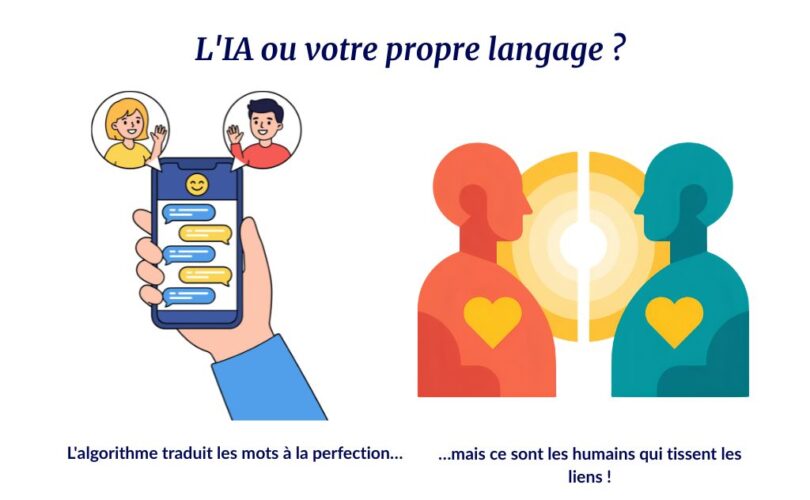
Oui. L’apprentissage d’une langue étrangère a toujours du sens, car dans un monde où la technologie et l’intelligence artificielle sont omniprésentes, la maîtrise des langues vous confère un atout personnel et un avantage concurrentiel.
Chaque jour, vous utilisez des applications de traduction ; Google traduit pour vous les pages web que vous consultez en langues étrangères, et les derniers modèles de smartphones et d’écouteurs proposent une traduction simultanée de chaque appel téléphonique dans des dizaines de langues. Des solutions basées sur l’IA rédigent des e-mails pour vous dans la langue de votre choix.
En vacances, grâce à votre téléphone, vous pouvez facilement commander un café, réserver un hôtel ou acheter un billet pour un musée. Dans un monde comme celui-ci, vous n’avez pas besoin de connaître la langue pour vous faire comprendre ! Tout ce dont vous avez besoin, c’est un smartphone avec une batterie chargée et un accès à Internet.
Comment l’intelligence artificielle et les outils de traduction peuvent-ils nous aider ?
Un langage purement fonctionnel
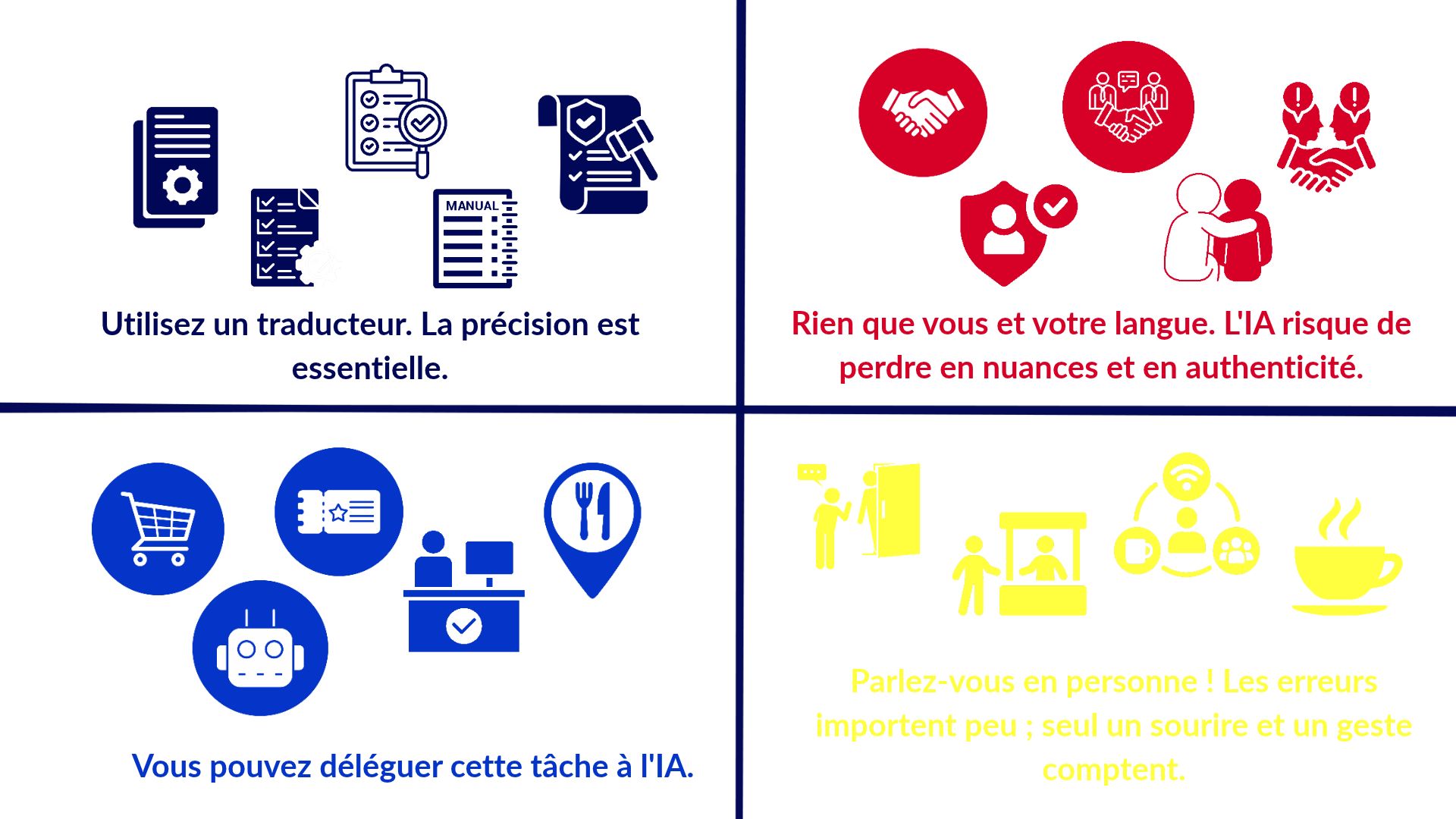
Les outils de traduction et l’intelligence artificielle peuvent être d’une grande aide pour traduire des documents tels que des manuels d’utilisation ou des spécifications techniques d’appareils, en particulier lorsque l’on n’a pas affaire à une terminologie spécialisée propre à un domaine particulier. Dans les documents techniques, il n’y a pas de place pour l’interprétation : il n’y a que des données techniques et un langage dénué d’émotion. Dans ce contexte, l’utilisation d’outils de traduction automatique est pratique et permet de gagner beaucoup de temps.
Les outils basés sur l’IA constituent également un bon choix pour rédiger des instructions standard ou des messages simples. Ils peuvent aussi s’avérer utiles lors d’un voyage à l’étranger. Si vous ne maîtrisez pas la langue, vous pouvez utiliser cette technologie pour vous enregistrer à l’hôtel, commander un café au restaurant ou acheter des billets de musée sans difficulté. Cela vous confère une certaine autonomie. Vous n’avez pas besoin de compter sur vos amis, votre partenaire ou vos enfants, qui maîtrisent mieux la langue que vous. Mais, cette indépendance n’est qu’apparente, car vous devenez dépendant des appareils, de la couverture mobile, de votre forfait de données et d’une connexion Internet stable.
La zone de confort numérique
Une autre façon tentante d’utiliser l’intelligence artificielle consiste à rédiger des e-mails professionnels, à préparer des présentations ou à élaborer des propositions commerciales. À quelle vitesse pouvez-vous répondre à des messages lorsque vous pouvez tout écrire dans votre langue maternelle, puis le faire traduire automatiquement, ou créer une consigne et demander à des modèles d’IA de rédiger l’ensemble dans la langue de votre choix ? Posez-vous la question : le résultat sera-t-il vraiment correct ?
Rapidement : oui ; correctement : pas tout à fait. Lorsqu’un modèle d’IA génère différents types de contenu (e-mails, présentations, etc.), il analyse d’abord les données sur lesquelles il a été entraîné, identifie ensuite des schémas au sein de ces données, puis les utilise pour créer le texte dont vous avez besoin. Dans un e-mail généré par l’IA, votre style de communication personnel se perd. À moins, bien sûr, que vous n’ayez préalablement entraîné votre modèle à écrire exactement comme vous.
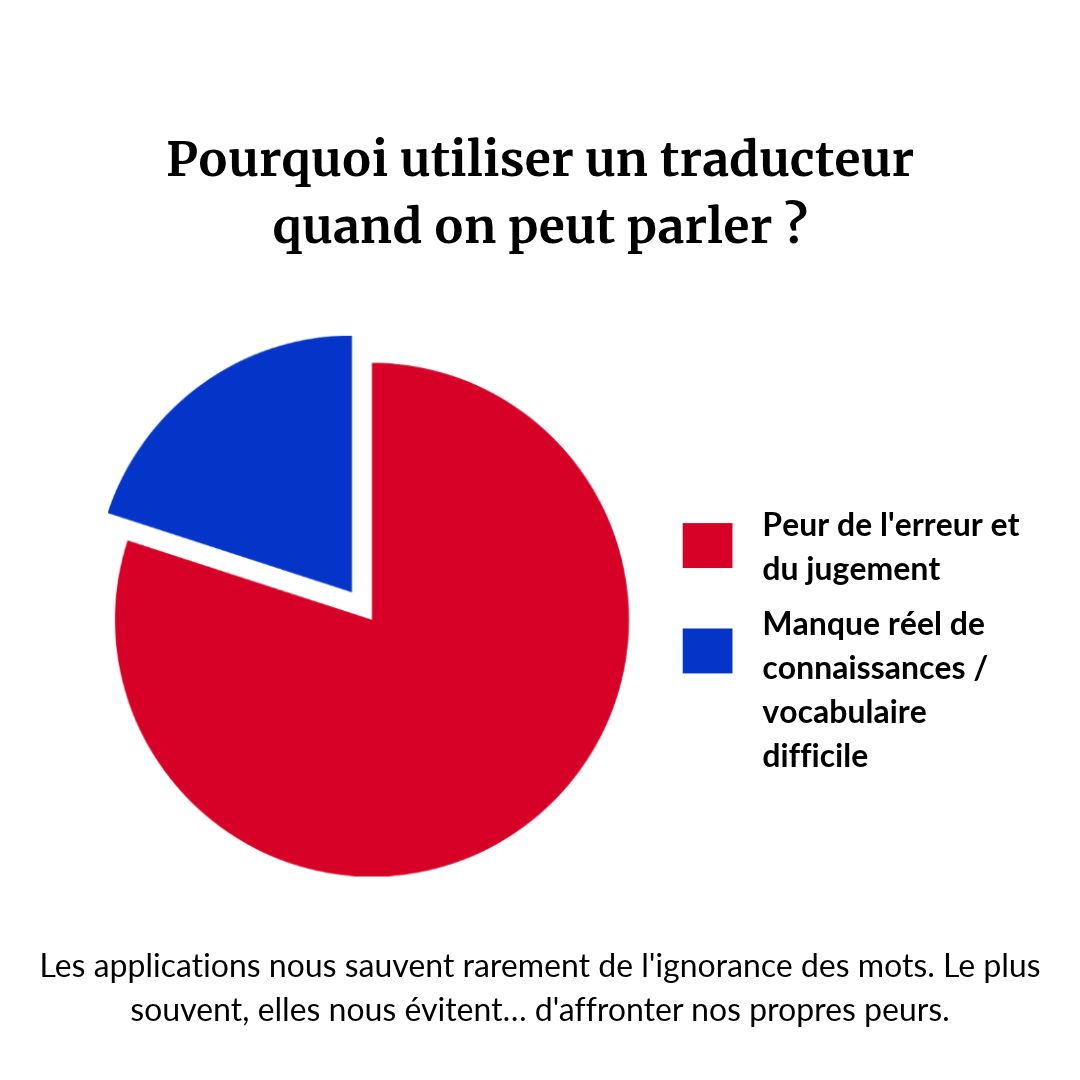
Vous comptez sur l’intelligence artificielle dans votre travail quotidien parce que vous craignez que votre maîtrise de la langue ne soit pas à la hauteur. Mais, au lieu de développer vos compétences, vous vous cachez derrière votre écran. Vous vous sentez en confiance lorsque vous écrivez et évitez les situations où vous devez prendre la parole. Parce que vous savez que lorsque vous le faites, votre bulle éclate, le stress vous paralyse et vous analysez chaque mot avant de le prononcer à voix haute.
Quel est l’impact de l’apprentissage d’une langue étrangère sur votre cerveau ?
Les bienfaits biologiques
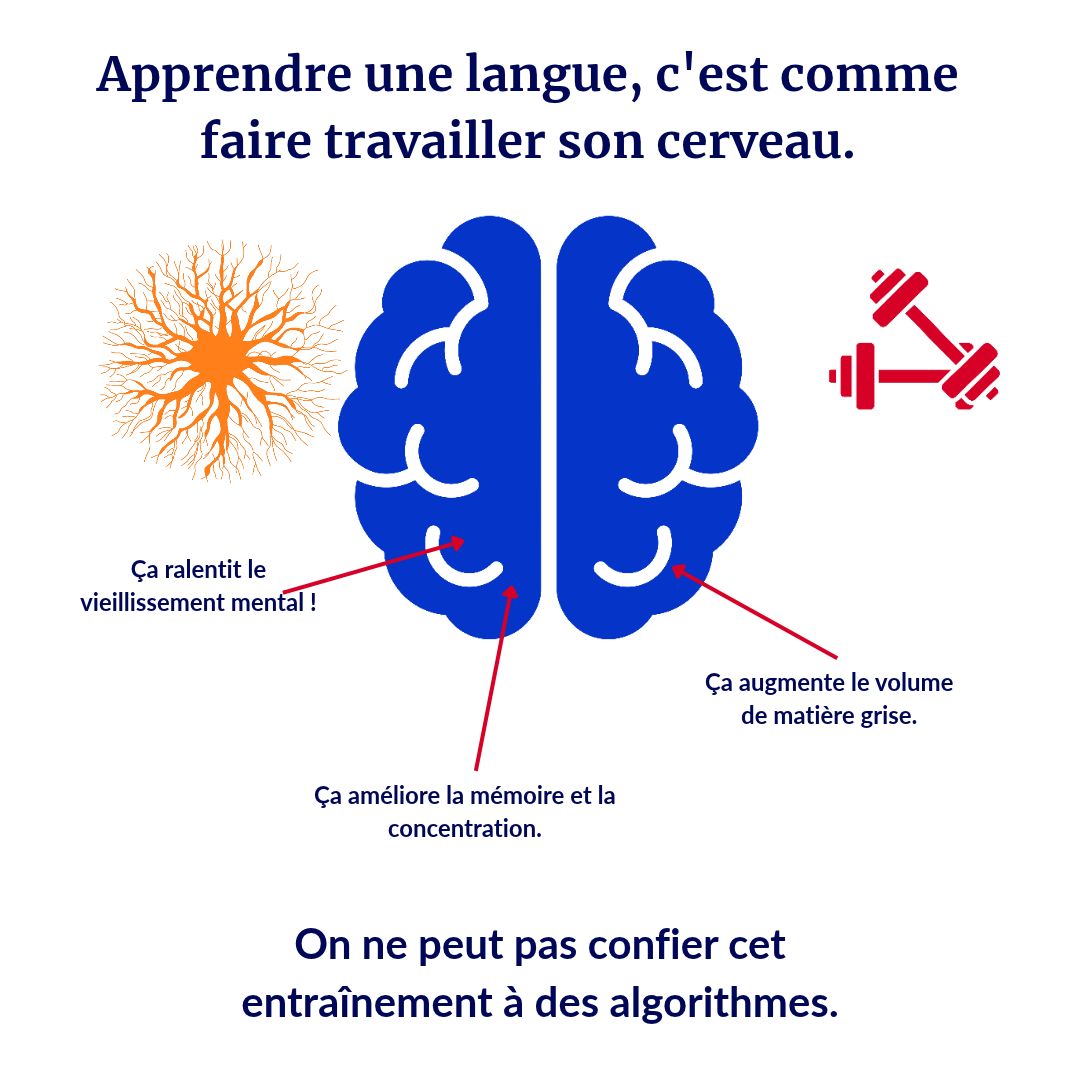
Les scientifiques s’accordent à dire que la maîtrise d’une langue étrangère modifie la structure de notre cerveau. Le processus d’apprentissage peut être comparé à un entraînement en salle de sport, à la différence que nous renforçons notre cerveau plutôt que nos muscles. En apprenant une autre langue, nous renforçons les connexions entre les neurones, ce qui rend le cerveau plus efficace et plus souple, car cela oblige l’esprit à créer de nouvelles connexions neuronales, développe notre capacité d’adaptation et nous rend plus résistants au passage du temps. Mémoriser du nouveau vocabulaire, apprendre des structures grammaticales et passer d’une langue à l’autre stimulent la neuroplasticité du cerveau et entraînent des changements physiques en son sein.
Comme le démontrent K. Coulter et N. A. Phillips dans leur article « Les personnes bilingues présentent des signes de préservation cérébrale face à la maladie d’Alzheimer », l’utilisation de plusieurs langues stimule des changements structurels bénéfiques dans le tissu neuronal. On a également constaté que les personnes bilingues présentaient un volume de matière grise plus élevé, notamment dans le gyrus cingulaire antérieur, le lobe pariétal inférieur et le cervelet. Le bilinguisme est associé à une épaisseur corticale accrue dans le gyrus frontal inférieur, ainsi qu’à un élargissement des structures sous-corticales, telles que les ganglions de la base et le thalamus.
Des études d’imagerie ont montré que, chez les personnes monolingues atteintes de la maladie d’Alzheimer, le volume de l’hippocampe diminue de manière significative, alors que, chez les personnes bilingues portant le même diagnostic, il reste nettement plus important et mieux préservé. Le bilinguisme agit principalement comme un mécanisme de préservation de la structure cérébrale, en inhibant la dégradation neurobiologique progressive associée à la maladie d’Alzheimer. Cela peut retarder l’apparition des symptômes de 4 à 5 ans par rapport à celle des personnes monolingues. Il convient toutefois de noter que des effets protecteurs plus marqués et un délai d’apparition des symptômes sont observés dans les cas d’utilisation active et régulière d’une deuxième langue, plutôt que dans le cas d’une simple connaissance passive de celle-ci.
Avantages psychologiques et sociaux
Outre les bénéfices purement biologiques, l’apprentissage d’une langue étrangère apporte de nombreux avantages psychologiques et sociaux. L’acquisition d’un nouveau système de communication favorise l’autodiscipline et la patience, car la régularité est essentielle pour obtenir des résultats tangibles. Le fait de surmonter progressivement les blocages mentaux internes et les barrières à la communication renforce la confiance en soi et la conviction de sa propre capacité à agir. De plus, l’apprentissage d’une langue étrangère stimule les fonctions cognitives du cerveau, telles que la capacité à planifier, à résoudre des problèmes et à exercer son esprit critique. Cela s’explique par le fait que les personnes qui parlent plus d’une langue traitent l’information plus rapidement et sont capables de sortir des sentiers battus.
Dans l’article « Langue et leadership : comment les managers bilingues améliorent la productivité des équipes », les auteurs ont démontré que les managers bilingues améliorent la circulation de l’information, expliquent clairement les objectifs et réduisent le risque d’erreurs coûteuses au sein des équipes. De plus, la connaissance des langues parlées par les membres de l’équipe atténue le sentiment d’isolement chez les locuteurs non natifs, ce qui accroît leur satisfaction professionnelle et réduit le taux de rotation du personnel. Elle facilite également l’intégration des nouveaux collaborateurs, permet de résoudre rapidement les conflits et stimule la créativité en réunissant des perspectives culturelles diverses. Par ailleurs, la maîtrise des langues étrangères permet d’établir directement des relations avec des partenaires étrangers et d’améliorer la qualité du service client.
Comme le montrent les analyses présentées dans le rapport *L’impact de l’apprentissage tout au long de la vie sur le bonheur et le bien-être*, l’apprentissage tout au long de la vie chez les adultes (y compris l’apprentissage des langues) va de pair avec une meilleure estime de soi et une plus grande satisfaction dans la vie. Se lancer dans un apprentissage à l’âge adulte renforce considérablement la confiance en soi, l’acceptation de soi et le sentiment d’autonomie personnelle. De plus, l’apprentissage continu et l’acquisition de connaissances réduisent le risque de symptômes dépressifs, développent les compétences sociales, facilitent la gestion du stress quotidien et augmentent la satisfaction globale à l’égard de la vie.
Pourquoi en est-il ainsi ? Parce que pour maîtriser une nouvelle langue, il faut sortir de sa zone de confort. En améliorant vos compétences linguistiques, vous surmontez vos propres limites et vous vous motivez à prendre de nouvelles initiatives. La maîtrise d’une langue étrangère renforce la conviction que vous êtes capable de relever des défis exigeants, ce qui, à son tour, vous encourage à entreprendre des actions plus audacieuses.
La communication ne se résume pas aux mots
Lire entre les lignes
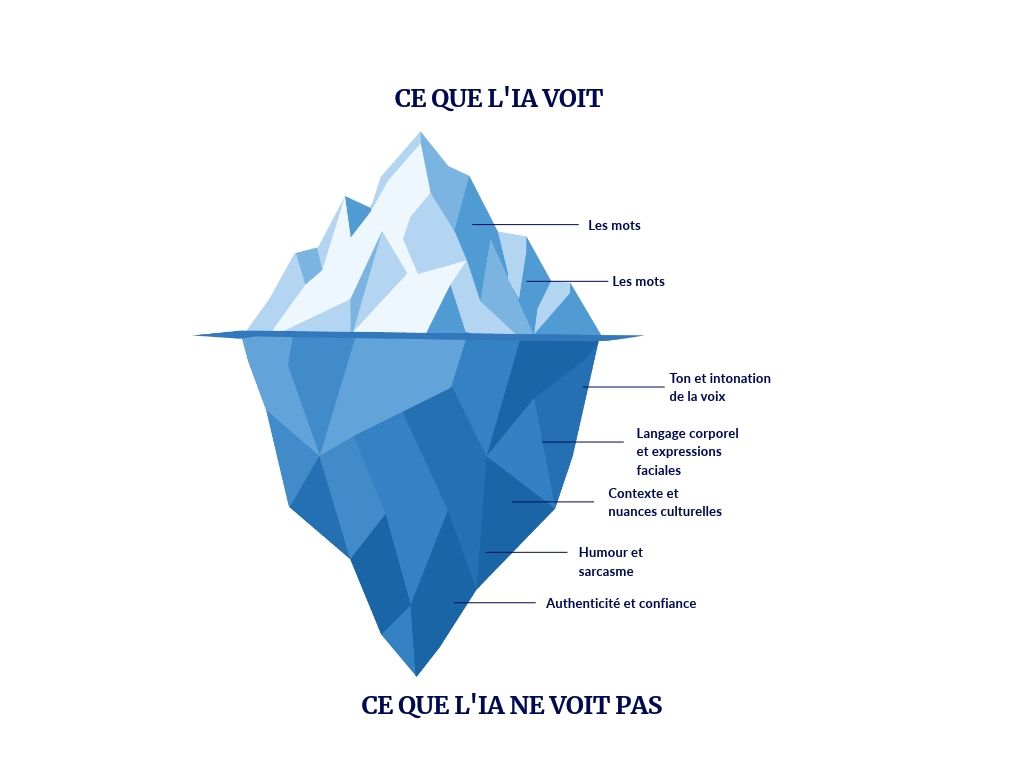
Dans la communication, les mots ne sont pas le seul élément qui compte. Dans les années 1960, le professeur et psychologue américain A. Mehrabien a identifié trois composantes de la communication interpersonnelle (dans des situations émotionnelles et lorsque le message est ambigu) :
le contenu, qui représente 7 % du message ;
le ton de la voix, qui représente 38 % du message ;
la communication non verbale, qui représente 55 % du message.
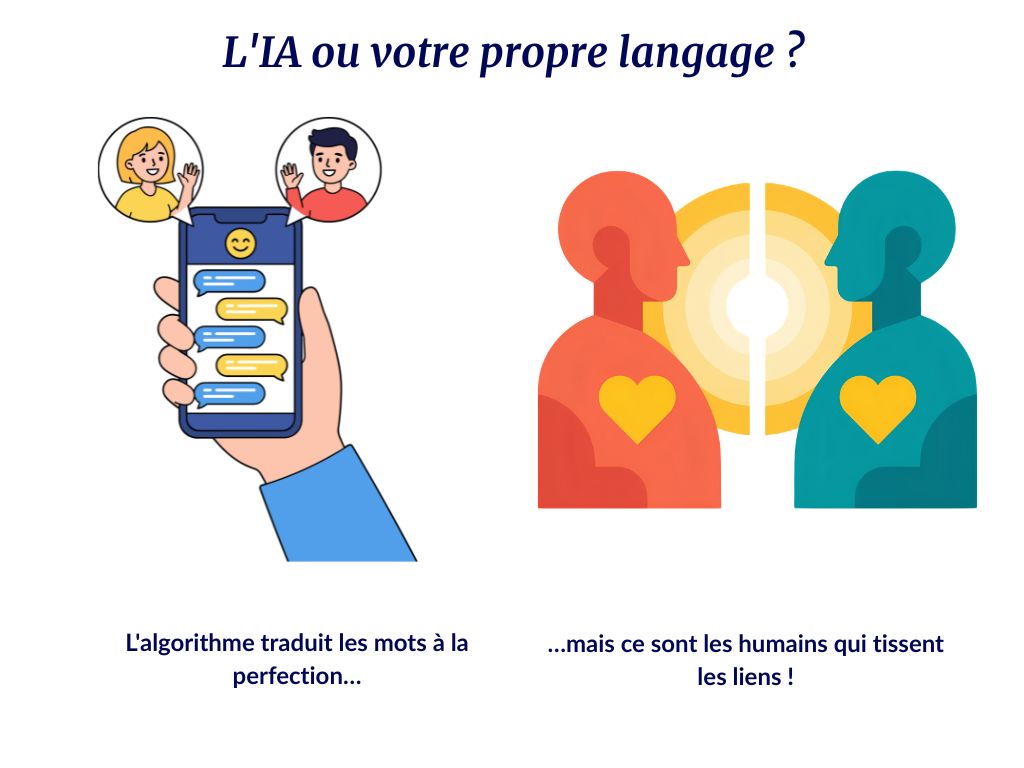
Les outils de traduction et les modèles d’IA utilisés pour la traduction s’appuient uniquement sur le contenu, sans tenir compte des autres composantes de la communication. Ils ne sont pas capable à transmettre les émotions, le ton de la voix ou les nuances culturelles, que nous, en tant qu’êtres humains, percevons intuitivement. Les modèles d’IA ont encore du mal à traduire les jeux de mots, les expressions idiomatiques, l’ironie ou les discussions à plusieurs niveaux. Cela conduit à une superficialisation des relations, à des malentendus et à des simplifications excessives. L’intelligence artificielle nous aidera à comprendre et à analyser les rapports d’activité, mais elle ne peut pas remplacer le contact direct avec une autre personne. Car c’est précisément grâce au contact avec les autres que nous développons la capacité à « lire entre les lignes », l’empathie, la capacité à nouer des relations et la liberté d’expression. Ce sont là des compétences hors de portée des machines, raison pour laquelle la maîtrise des langues étrangères reste très prisée.
La confiance
La maîtrise des langues étrangères ouvre la voie à la compréhension d’autres cultures, ce qui favorise en nous la sensibilité et l’ouverture d’esprit. Il est bien plus facile de négocier et de nouer des partenariats commerciaux lorsque l’on parle une langue commune, sans avoir besoin d’un intermédiaire technologique. La communication devient plus aisée lorsque l’on se concentre non seulement sur le contenu, mais aussi sur les émotions, le langage corporel et le ton de la voix.
Dans cette perspective, les vacances deviennent une expérience différente. En parlant la langue du lieu que l’on visite, on gagne en autonomie, en sentiment de sécurité et en confiance pour explorer des endroits hors des sentiers battus. Je me suis rendu deux fois sur la même île. La première fois, je ne parlais qu’anglais. Mon séjour a été agréable, mais je ne me suis pas trop aventuré au-delà des zones purement touristiques. La deuxième fois, j’y suis allé avec des connaissances de base de leur langue. Et mon expérience a été complètement différente. Le personnel de l’hôtel m’a aidé à organiser des visites de lieux hors des sentiers battus en me donnant de bons conseils. Même si mes compétences linguistiques n’étaient pas haut niveau et que j’ai souvent dû me rabattre sur l’anglais, les habitants se sont montrés bien plus accueillants à mon égard que lors de ma première visite. C’est précisément de ce deuxième voyage que je garde les meilleurs souvenirs et les expériences les plus marquantes.
Vaut-il la peine d’utiliser des outils de traduction et d’IA ?
Bien sûr que oui. Mais, seulement si vous les utilisez de manière consciente et en assumant pleinement vos responsabilités. Ne traduisez pas tout automatiquement. Essayez de lire et d’écrire vos messages vous-même. Oui, je sais, la méthode du « copier-coller » ne prend qu’une fraction de seconde, mais en écrivant vous-même, vous entraînez votre cerveau, vous améliorez vos compétences et vous facilitez la rédaction de chaque e-mail suivant. Si vous n’avez pas confiance en vos compétences linguistiques, installez une application ou une extension de navigateur qui vérifie l’orthographe et la grammaire. Certes, cela n’écrira pas le message à votre place, mais cela vous aidera à éviter les erreurs. J’utilise moi-même ce genre d’applications depuis des années, même lorsque j’écris dans ma langue maternelle, ce qui m’aide à éliminer les fautes de frappe et d’autres erreurs mineures. Ainsi, je sais que le message que j’envoie est exempt d’erreurs flagrantes.
L’IA comme partenaire d’entraînement dans l’apprentissage des langues
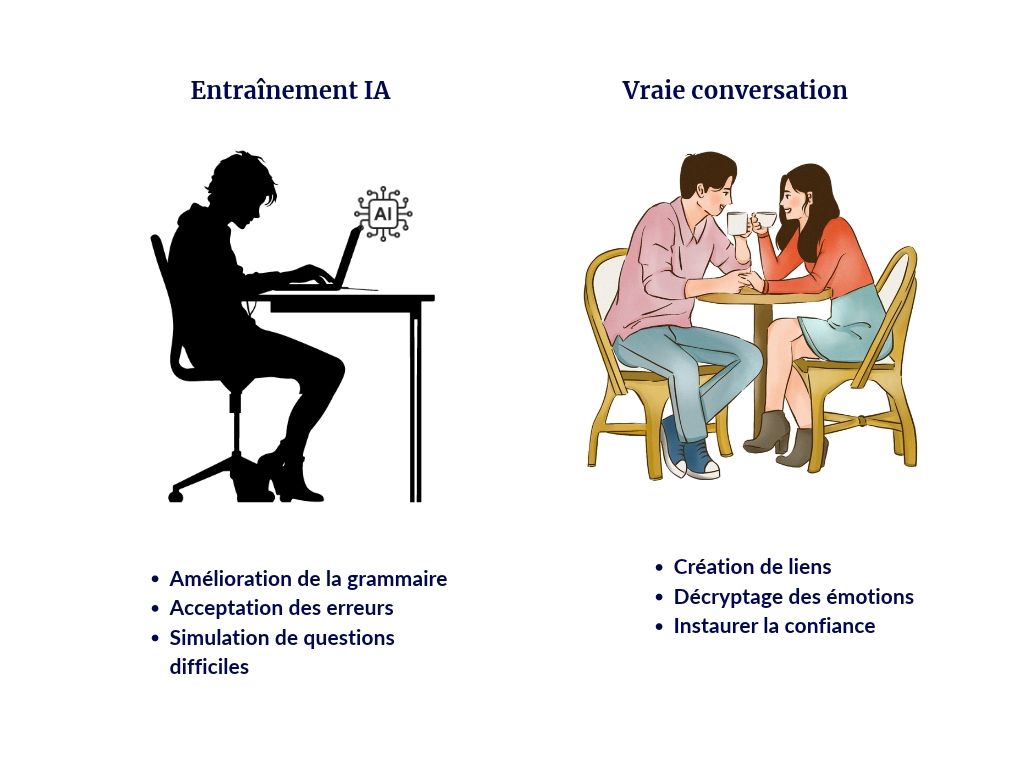
Utiliser l’IA pour apprendre une langue étrangère est une excellente idée. Des outils tels que Gemini et ChatGPT fonctionnent parfaitement comme tuteurs virtuels. Ils disposent d’une fonctionnalité d’apprentissage qui vous permet de configurer votre propre assistant pour qu’il vous prépare une nouvelle leçon chaque jour. Il existe également sur le marché d’autres outils et applications basés sur l’IA, spécialement conçus pour l’apprentissage des langues étrangères. Je dois avouer que j’utilise moi-même la fonctionnalité d’apprentissage de Gemini pour rafraîchir mes connaissances dans une langue que je n’ai pas pratiquée depuis 18 ans. Cela vaut la peine d’essayer si, comme moi, vous souhaitez rafraîchir vos compétences linguistiques ou commencer à apprendre à partir de zéro. Cette solution est disponible à tout moment ; vous n’avez donc aucune excuse pour invoquer un manque de temps ou pour avoir du mal à trouver un professeur disponible après 22 heures.
Un entraînement personnalisé grâce à l’IA vous aidera à devenir plus à l’aise à l’oral et à vous préparer en amont d’une réunion importante. N’oubliez pas, cependant, que l’algorithme n’est qu’un simulateur et ne peut pas remplacer une conversation avec une autre personne.
Authenticité ou perfection numérique
Entourés par la technologie moderne, nous oublions souvent que l’authenticité prime sur la perfection en matière de communication. Nous souhaitons parler et écrire dans une langue étrangère avec autant d’aisance que dans notre langue maternelle, tout en oubliant souvent que nous commettons également des erreurs dans notre langue maternelle et que nous les considérons comme tout à fait naturelles. L’intelligence artificielle recèle un potentiel énorme, et la manière dont elle influence votre vie dépend entièrement de vous. Vous pouvez en devenir esclave ou l’utiliser comme un outil pour développer vos compétences.
En tant que coach en langues et en communication vivant à l’étranger et utilisant quatre langues au quotidien, je peux affirmer une chose : communiquer avec aisance, c’est atteindre un bien-être intérieur, surmonter ses propres peurs, nouer des relations authentiques et retrouver une pleine autonomie – ce qu’aucune application ne peut faire à votre place.
Quel est votre point de vue sur l’intelligence artificielle ? Va-t-elle prendre le contrôle de nos conversations, réduisant l’apprentissage des langues étrangères à un simple passe-temps coûteux ? Partagez votre avis dans les commentaires.
We use cookies to personalise content and ads, to provide social media features and to analyse our traffic. We also share information about your use of our site with our social media, advertising and analytics partners. View more
Cookies settings
Accept
Decline
Privacy & Cookie policy
Privacy & Cookies policy
Cookies list
Cookie name
Active
Hello!If you come here, it is a sure sign that you value your privacy. I understand this perfectly, so I will give you a document where you will find the rules for processing personal data and using cookies and other tracking technologies in one place.Formal information at the beginning: the administrator of your personal data is me, i.e. Lingua Impact Agnieszka Kujawska, 684 rue du Chevalleret Z.A. de Moru, 60700 Pontpoint, France.I process your personal data primarily for the purposes related to your use of my website and social media. These include newsletter support, comment service, social media support, message exchange, analysis, statistics, marketing, etc.I process your personal data for the period necessary to implement individual purposes. You have the right to access, rectify, delete or limit the processing of your personal data, object to the processing, and data portability.Detailed information on the principles of processing your personal data can be found later in the Privacy Policy.If you have any doubts related to the Privacy Policy, you can contact me at any time by sending a message to contact@linguaimpact.eu.
1: Who is the administrator of your personal data?
The administrator of your personal data is me, i.e. Lingua Impact Agnieszka Kujawska, 684 rue du Chevalleret Z.A. de Moru, 60700 Pontpoint, France.This Privacy Policy applies to the website www.lingua-impact.eu.In the scope of my social media profiles, in accordance with the case law of the Court of Justice of the European Union, I am the data controller with the provider of social networks in which I have profiles. Details on the processing of personal data by individual providers of social networks can be found here:
2: Who can you contact regarding the processing of your personal data?
As part of the implementation of personal data protection in my office, I decided not to appoint a personal data protection officer due to the fact that it is not obligatory in my situation. In matters related to the protection of personal data and broadly understood privacy, you can contact us at contact@linguaimpact.eu. In the field of social media, you can additionally contact the administrators of social networks where I run my profiles directly.
3: For what purposes do I process personal data?
There is more than one of these goals. Below is a list of them, along with a more detailed overview. Appropriate legal bases for processing have also been assigned to specific purposes:
Purpose of processing
Discussion of the purpose of processing
Legal basis
newsletter handling
When subscribing to the newsletter, you must provide the data necessary to receive it specified in the subscription form.
Providing data is a prerequisite for receiving the newsletter.
In addition, the system used to handle the newsletter saves your IP number that you used when subscribing to the newsletter, determines your approximate location, the e-mail client you use to handle e-mail and tracks your actions taken in connection with the messages sent to you. Messages. Therefore, I also have information about the messages you opened, the messages in which you clicked on links, etc.
In the mailing system, we may also define, based on various criteria related to your activity, interests or other preferences, specific groups or segments of newsletter recipients that affect what kind of newsletters you receive.
The data provided by you in connection with the subscription to the newsletter is used to operate the newsletter, which is my legally justified interest, which in this case, is the implementation of marketing objectives.
Regarding the processing of information that does not come from you and has been collected automatically by the mailing system, we rely in this respect on our legitimate interest in analysing the behaviour of newsletter subscribers in order to optimise mailing activities.
You can unsubscribe from the newsletter anytime by clicking on the dedicated link in each message sent as part of the newsletter or by simply contacting me.
Unsubscribing from the newsletter does not lead to deleting your data from the mailing system. The data goes to the archive for the purpose of possible determination, investigation or defence of claims related to the newsletter, as well as to ensure the possibility of demonstrating that the newsletter activities were carried out in accordance with the law.
Regulation (EU) 2016/679 on the protection of individuals with regard to the processing of personal data and on the free movement of such data
comment support
When adding a comment on my website, you must provide the data necessary to publish the comment specified in the form intended for issuing a comment/opinion.
Providing data is a condition for publishing a comment.
In addition, the comment system saves your IP number that you used by submitting a comment.
An external provider can operate the comment system. In such a situation, the use of the system is subject to the external supplier's regulations and privacy policy. Detailed information about third-party tool providers can be found in the section dedicated to the tools I use.
The data is processed in order to publish a comment, which is my legitimate interest.
The comment you have added, along with your data published as part of the settings, will be visible on the page. You can modify or delete a comment at any time. The deleted comment, together with your data, goes to the archive for the purpose of possible establishment, investigation or defence of claims related to the comment.
Regulation (EU) 2016/679 on the protection of individuals with regard to the processing of personal data and on the free movement of such data
contact and handling of correspondence
By contacting me via available means of communication, e.g. e-mail, social messengers, chats, etc., you naturally provide your personal data contained in the content of the correspondence.
Providing data is a prerequisite for establishing contact.
In addition, the communication system records your IP address, which you use to send a message.
The communication system (e.g. chat, messenger) can be operated by an external provider. In such a situation, the use of the system is subject to the external supplier's regulations and privacy policy.
Detailed information about third-party tool providers can be found in the section dedicated to the tools I use.
The data is processed for the purpose of communication, which is my legitimate interest. Once the communication is complete, the data goes to the archive for the purposes of possible establishment, pursuit or defence of claims related to the conducted communication.
Regulation (EU) 2016/679 on the protection of individuals with regard to the processing of personal data and on the free movement of such data
creating an archive
For the purposes of my activity, I can create archives in digital form. The archives contain personal data that I have processed in connection with you, and their scope may vary depending on what data I have received and what scope of data is justified from an archival point of view. In this case, I rely on our legitimate interest in organising and organising personal data carriers.
Regulation (EU) 2016/679 on the protection of individuals with regard to the processing of personal data and on the free movement of such data
defence, establishment or redress
Using my website may give rise to certain claims on your or my part in the future. Therefore, I am entitled to process personal data to defend, establish or pursue claims. As part of this purpose, I may process any personal data that relates to a given claim; therefore, their scope may vary depending on what the claim relates to. In this case, I rely on my legitimate interest in protecting my interests.
Regulation (EU) 2016/679 on the protection of individuals with regard to the processing of personal data and on the free movement of such data
creating ad audience groups
Your e-mail address stored in my database may be sent to a specific advertising system (e.g. Facebook Ads, LinkedIn Ads) to create a group of advertising recipients using this e-mail address.
When using this feature, the e-mail address is hashed before being sent to Facebook to form an audience.
The e-mail address will be used in the matching process carried out by the respective advertising system.
Facebook does not share the e-mail address with third parties or other advertisers and deletes the e-mail address as soon as the matching process is completed.
Facebook has implemented processes and procedures to ensure the confidentiality and security of the e-mail address sent to it and the set of Facebook user identifiers that create a group of recipients created using the e-mail address, among other things, through the use of technical and physical security.
Creating a group of advertising recipients using your e-mail address is my legitimate interest, which in this case, is implementing my marketing goals.
Regulation (EU) 2016/679 on the protection of individuals with regard to the processing of personal data and on the free movement of such data
handling social media
Suppose you follow our profiles on social networks or interact with the content we publish on social media. In that case, we naturally see your data publicly available on your social profile.
We process this data only within a given social networking site and only to operate a given social networking site, which is our legitimate interest referred to in art.
If you contact me via a private message, you naturally provide me with your personal data contained in the content of the correspondence, in particular the image and the name and surname. In this case, your data is processed in order to contact you, and the basis for processing is my legitimate interest.
It may happen that I will be the party initiating contact with you via social media in order to offer cooperation; then, your data will be processed in order to search for potential contractors and offer and establish cooperation, which is my legitimate interest.
Messages sent to me via social media are subject to automatic archiving by means of the tools available within individual social networks. They are available to me until you delete them. You can view all messages listed with me in the private messages tab.
Your use of social networks is subject to the regulations and privacy policies of the administrators of these websites, and these administrators provide you with services by electronic means, entirely independently and independently of us.
Regulation (EU) 2016/679 on the protection of individuals with regard to the processing of personal data and on the free movement of such data
analysis and statistics using only Anonymous Information
I conduct analytical and statistical activities using tools provided by external suppliers. As part of the analytical tools, we only have access to Anonymous Information. The processing of Anonymous Information is based on a legitimate interest, which consists in creating, reviewing and analysing statistics related to the activity of users on the website in order to draw conclusions allowing for the subsequent optimization of my activities.
From the level of Google Analytics and Facebook tools, we only have access to a set of statistics and information not assigned to specific people.
Detailed information about third-party tool providers can be found in the section dedicated to the tools I use.
Regulation (EU) 2016/679 on the protection of individuals with regard to the processing of personal data and on the free movement of such data
own marketing using only Anonymous Information
I conduct marketing activities using tools provided by external suppliers. We only have access to Anonymous Information as part of the analytical tools. I base the processing of Anonymous Information on a legitimate interest, which consists in conducting marketing activities based on Anonymous Information and targeting advertisements within external systems based on Anonymous Information, for the purposes of marketing my own products and services. From the level of Google Analytics and Facebook tools, we only have access to a set of statistics and information not assigned to specific people.
Detailed information about third-party tool providers can be found in the section dedicated to the tools I use.
Regulation (EU) 2016/679 on the protection of individuals with regard to the processing of personal data and on the free movement of such data
provision of additional functions using only Anonymous Information
On my website, I can embed video or audio players, social widgets, comment modules, chat, newsletter forms or other tools provided by third parties. All these tools process Anonymous Information. The processing of Anonymous Information is based on a legitimate interest, which in this case consists in ensuring the possibility of using additional functions on the website. From the level of tools, I have no insight into others' information; in addition, I do not need this information for anything – Anonymous Information is processed only so that additional functions can work. Detailed information about third-party tool providers can be found in the section dedicated to the tools I use.
Regulation (EU) 2016/679 on the protection of individuals with regard to the processing of personal data and on the free movement of such data
obligations related to the protection of personal data
As a personal data administrator, I am obliged to implement obligations related to protecting personal data. Therefore, I may process your personal data insofar as it is necessary to perform these obligations (e.g. in the case of processing your request regarding your personal data). The scope of data depends on what data is needed to fulfil the obligation and prove compliance with the protection of personal data. In addition, in this case,
I also rely on my legitimate interest, which consists in securing the data necessary to demonstrate accountability.
Regulation (EU) 2016/679 on the protection of individuals with regard to the processing of personal data and on the free movement of such data
4: What information do I have about you?
The scope of the processed data is described in relation to each processing purpose. Information in this regard can be found above, in point 3 of the Privacy Policy. The data includes information such as:
first name,
e-mail address,
IP address,
data collected in the mailing system,
data related to the added comment,
information visible in social media profiles,
information contained in correspondence,
Anonymous Information.
5: What is "Anonymous Information"?
Moreover, we use tools that collect a lot of information about you related to the use of our website. It concerns, in particular, the following information:
information about the operating system and web browser,
subpages viewed,
time spent on the page,
transitions between individual subpages,
clicks on individual links,
Mouse movements
scrolling the page,
the source from which you go to the site,
the age range you are in,
YOUR Gender
Your approximate location is limited to the town.
Your interests are based on your online activity.
video recordings of your sessions on my pages,
heat maps illustrating your behaviour on my pages.
This information is referred to in this Privacy Policy as "Anonymous Information".Anonymous information by itself is not, in our opinion, personal information, as it does not allow us to identify you, and we do not match it with the typical personal information we collect about you. Nevertheless, taking into account the rigorous jurisprudence of the Court of Justice of the European Union and the divided opinions among lawyers, as a precautionary measure in the event that Anonymous Information is assigned the nature of personal data, we have also included detailed explanations in this privacy policy regarding the processing of this information.We are unable to provide you with access to Anonymous Information about you, as we cannot assign any of the Anonymous Information to any specific user. From the level of Google Analytics and Facebook tools, we only have access to a set of statistics and information not assigned to specific people.The processing of Anonymous Information allows you to use the functionalities available on the website. In addition, Anonymous Information is used for analytical, statistical, and marketing purposes, such as setting and targeting advertisements.Anonymous information is also processed by tool providers on the basis of their regulations and privacy policies. Anonymous Information is also used by the providers of individual tools to provide and improve services, manage them, develop new services, measure the effectiveness of advertisements, protect against fraud and abuse, as well as personalise the content and advertisements displayed on individual websites, sites and applications. Detailed information on this can be found in the section dedicated to the tools we use.
6: Where did I get your personal data from?
In most cases, you pass them on to us yourself. For example, this happens when you subscribe to the newsletter, contact via e-mail or chat, and use the functionalities available on the website or external services (e.g. social networks).In addition, some information about you may be automatically collected by the tools I use: Detailed information about third-party tool providers can be found in the section dedicated to the tools I use.
7: Is the data safe?
I care about the safety of your personal information. We have analysed the risks associated with individual data processing processes and then implemented appropriate security and personal data protection measures. I monitor the condition of the technical infrastructure on an ongoing basis, train staff, observe the procedures applied, and introduce necessary improvements.
8: How long will I keep my personal data?
We process your personal data for as long as it is justified within a given purpose of personal data processing; therefore, the processing periods vary depending on the purpose. Please note that the termination of the processing of your data for one purpose does not necessarily lead to the complete deletion or destruction of your personal data because the same set of data may be processed for another purpose for the period indicated for it. Complete deletion or destruction of data takes place when I have completed all purposes and, in other cases, indicated in Regulation (EU) 2016/679 on the protection of natural persons with regard to the processing of personal data and on the free movement of such data.Below you will find a description of the processing periods:
Newsletter – data related to the newsletter will be processed for the duration of your use of the newsletter;
Comments- data related to the posting of a comment will be processed until you delete the comment;
Contact and handling of correspondence – data related to the handling of correspondence will be processed for the duration of the contact between us;
Archive – data related to the archive will be processed until the usefulness of the information contained in the archive expires;
Establishing, pursuing and defending claims – data related to claims will be processed until the claims are time-barred, whereby the period of limitation of claims may vary in the light of applicable law;
Audience groups – data related to audiences will be processed until it becomes unusable or you effectively raise an objection;
Social media – in principle, I have no influence on the period of storage of your personal data in social media. They are available on Facebook, Instagram, YouTube or LinkedIN on the basis of the regulations and privacy policies of these services. I am not able to delete your data from Facebook, Instagram, YouTube or LinkedIN – only you can do it;
Analysis and statistics – data related to analytics and statistics will be processed until they expire or you effectively object;
Self-marketing – data related to self-marketing will be processed until it ceases to be useful or you effectively raise an objection;
Additional tools – data related to additional tools will be processed until they expire or you effectively raise an objection;
Obligations related to the protection of personal data – data related to the protection of personal data will be processed until its expiration, effective objection by you or expiry of the limitation period of my liability as a personal data administrator.
If I process your personal data on the basis of your consent, you can withdraw such consent at any time: either by your action or by contacting me at the contact details provided. Withdrawal of consent does not affect the lawfulness of processing carried out on the basis of consent before its withdrawal.
9: Who are the recipients of personal data?
We risk saying that modern business is not able to do without services provided by third parties. I also use such services. Some of these services are related to the processing of your personal data. External service providers who are involved in the processing of your personal data are:
hosting provider – for the purpose of storing data on the server;
mailing system provider – for the purposes of using the mailing system;
chat provider – for the purpose of contact via chat;
supplier of the pop-up display system – for the purpose of displaying pop-ups;
provider of a tool for managing landing pages – for the purpose of collecting data via landing pages;
a cloud computing provider – for the use of cloud solutions;
accounting office – for the purposes of using accounting services;
law firm – for the purposes of providing legal services to me;
technical service – for the purposes of carrying out technical works related to those areas in which data are processed;
other subcontractors, in particular IT solution providers – for the purposes of cooperation with various subcontractors who may have access to your personal data, if they provide services to the extent related to such access.
If necessary, your data may be made available to a legal advisor or attorney bound by professional secrecy. The need may arise from the need to use legal assistance that requires access to your personal data.In addition, if necessary, your personal data may be made available to entities, bodies or institutions authorised to obtain access to data on the basis of legal provisions, such as the police, security services, courts, and public prosecutor's offices.Moreover, when it comes to Anonymous Information, the providers of tools or plugins that collect Anonymous Information have access to it. The providers of these tools are independent administrators of the data collected in them and may share this data on the terms specified by them in their own regulations and privacy policies, over which I have no influence.
10: Do I transfer data to third countries or international organizations?
Yes, part of the processing of your personal data may involve their transfer to third countries.I transfer your personal data to third countries in connection with the use of tools using resources located in third countries, in particular in the USA. The providers of these tools guarantee an adequate level of protection of personal data through appropriate compliance mechanisms provided for by Regulation (EU) 2016/679 on the protection of natural persons with regard to the processing of personal data and on the free movement of such data, in particular through the use of standard contractual clauses.Currently, your personal data is transferred to third countries in connection with the use of the following solutions:
Type of solution
Solution provider
Third country
E-mail
Google
USA
Data Backup
Google
USA
In addition, Anonymous Information collected in connection with the use of the tools indicated in the Annex to this Privacy Policy may be transferred to third countries, in particular the USA.
11: Do I use profiling?
We do not make decisions for you based solely on automated processing, including profiling, which would have legal effects on you or similarly significantly affect you. Yes, we use tools that can take specific actions depending on the information collected as part of the tracking mechanisms. However, we believe that these actions do not have a significant impact on you because they do not differentiate your situation as a customer, do not affect the terms of the contract, which you can conclude with us, etc.By using certain tools, we can, for example, direct personalised advertisements to you based on your previous actions taken on the website or suggest products that may be of interest to you. I am talking about so-called behavioural advertising. We encourage you to learn more about behavioural advertising, in particular regarding privacy issues. Detailed information, along with the ability to manage your behavioural advertising settings, can be found here.
12: What are your rights?
Regulation (EU) 2016/679 on the protection of natural persons with regard to the processing of personal data and on the free movement of such data grants you the following potential rights in relation to the processing of your personal data:
the right to access your data and receive a copy of it
the right to rectify (correct) your data
the right to delete data (if, in your opinion, there are no grounds for me to process your data, you can request that I delete it),
the right to limit data processing (you can request that we limit the processing of data only to their storage or performance of activities agreed with you if, in your opinion, we have incorrect data or we process it unjustifiably),
the right to object to the processing of data (you have the right to object to the processing of data on the basis of a legitimate interest; you should indicate a specific situation that, in your opinion, justifies the termination of the processing covered by the objection; we will stop processing your data for these purposes unless we prove that the grounds for data processing by us override your rights or that your data is necessary for us to establish, assert or defend claims),
the right to transfer data (you have the right to receive from us, in a structured, commonly used, machine-readable format, personal data that you provided to us on the basis of a contract or your consent; you can commission us to send this data directly to another entity),
the right to withdraw consent to the processing of personal data if you have previously given such consent,
the right to lodge a complaint with the supervisory body (if you find that we are processing data unlawfully, you can file a complaint with the President of the Office for Personal Data Protection or another competent supervisory authority).
I encourage you to familiarise yourself with the provisions describing the rules related to the implementation of the above-mentioned rights. For our part, we consider it necessary to explain to you that the above-mentioned rights are not absolute, and you will not be entitled to all activities of processing your personal data.I emphasise that you always have one of the rights indicated above; if you consider that when processing your personal data, we have committed a violation of the provisions on the protection of personal data, you have the opportunity to lodge a complaint with the supervisory authority.
13: Do I use cookies and what are they exactly?
Our website, like almost all other websites, uses cookies.Cookies are small text information stored on your end device (e.g. computer, tablet, smartphone) that can be read by our ICT system (own cookies) or ICT systems of third parties (third-party cookies). In cookies, specific information can be saved and stored, which ICT systems can then access for specific purposes.Some of the cookies we use are deleted after the end of the web browser session, i.e. after closing it (so-called session cookies). Other cookies are stored on your device and enable us to recognize your browser the next time you access the site (permanent cookies).If you want to learn more about cookies, you can see, for example, this material.
14: On what basis do I use cookies?
We use cookies on the basis of your consent, except when cookies are necessary for the proper provision of electronic services to you.Cookies that are not necessary for the proper provision of electronic services remain blocked until you consent to the use of cookies. During your first visit to the website, we display a message asking for your consent along with the possibility of managing cookies, i.e. deciding which cookies you agree to and which you want to block.
15: Can you disable cookies?
Yes, you can manage cookie settings within your web browser. You can block all or select cookies. You can also block cookies from specific websites. You can also delete previously saved cookies and other websites and plug-in data at any time.Web browsers also offer the option of using incognito mode. You can use it if you do not want information about visited pages and downloaded files to be saved in your browsing and download history. Cookies created in incognito mode are deleted when all incognito windows are closed.Browser plug-ins are also available to control cookies, such as Ghostery. The option to control cookies may also be provided by additional software, in particular anti-virus packages, etc.In addition, there are tools available on the Internet that allow you to control certain types of cookies, in particular for the collective management of behavioural advertising settings.I also give you the ability to control cookies directly from my website. We have implemented a special cookie management mechanism that allows you to block cookies that you do not want. Remember that disabling or limiting the use of cookies may prevent you from using some of the functions available on our website and cause difficulties in using the website, as well as many other websites that use cookies. For example, if you block cookies from social plug-ins, buttons, widgets and social functions implemented on the website may not be available to you.
16: For what purposes do I use my own cookies?
Own cookies are used to ensure the proper functioning of individual mechanisms of the website, such as the correct submission of the form visible on the website, support for newsletter forms, etc. Own cookies also store information about the cookie settings defined by you, made from the level of the cookie management mechanism.
17: What third-party cookies are used?
A list of tools that require the use of cookies and a description of the cookies used can be found in the appendix to this Privacy Policy.
18: Do I track your behaviour on the site?
Yes, I use third-party providers to collect information about your activities on the site. These tools are described in detail in the appendix to this Privacy Policy.
19: Do I target you with targeted advertising?
Yes, I use Facebook Ads, under which I can target specific target groups defined on the basis of various criteria such as age, gender, interests, profession, job and activities previously undertaken on my website. These tools are described in detail in the appendix to this Privacy Policy.
20: How can you manage your privacy?
The answer to this question can be found in many places in this privacy policy when describing individual tools, behavioural advertising, consent to cookies, etc. Nevertheless, for your convenience, we have gathered this information once again in one place. Below you will find a list of options for managing your privacy.
cookie settings in the web browser,
browser plugins supporting the management of cookies, e.g. Ghostery;
additional cookie management software,
incognito mode in a web browser,
behavioural advertising settings, e.g. youronlinechoices.com,
As you can see, the subject of personal data processing, the use of cookies and privacy management, in general, is quite complicated. I have made every effort to. We have made every effort to ensure that this document provides you with as much knowledge as possible on issues important to you. If anything is unclear to you, you want to know more, or just talk about your privacy, write to me at contact@linguaimpact.eu.
22: Can this privacy policy be changed?
Yes, we can modify this privacy policy, in particular, due to technological changes and changes in the law. If you are a registered user, you will receive a message about each change to the Privacy Policy. Changes to the Privacy Policy shall take effect at the earliest after 7 days. All archived versions of the privacy policy are linked below.
Appendix to the Privacy Policy
LIST OF TOOLS USING COOKIES
Name of tool
Description of operation and cookies
Google Tag Manager
I use the Google Tag Manager tool provided by the US company Google LLC, which is a tool used to manage tags and load scripts within the site.
Google Tag Manager, as a tool itself, does not collect any information other than what is necessary for its proper operation. However, it is responsible for loading other scripts described below.
Google Analytics
I am using the Google Analytics tool provided by the US company Google LLC. In order to use Google Analytics, we have implemented a special Google Analytics tracking code in the website code. The tracking code uses Google LLC cookies for the Google Analytics service. You can block the Google Analytics tracking code at any time by installing the browser add-on provided by Google.
Google Analytics automatically collects information about your activity on my website. I emphasise that as part of Google Analytics, I only have access to Anonymous Information.
Thanks to the information collected in this way, I can analyse user behaviour on my website and keep statistics related to it, and then draw conclusions from these statistics in order to design solutions that improve the effectiveness of the website.
If you are interested in details related to Google's use of data from websites and applications that use Google services, I encourage you to read this information.
Meta Pixel
I use the Meta advertising system provided by the American company Meta Platform Inc. In order to target you with ads personalised in terms of your behaviour on my website, I have implemented Pixel Meta, which automatically transfers information about your activity on my website to the Meta advertising system.
As part of the Meta advertising system, I have access only to Anonymous Information.
Thanks to the information collected in this way, I am able to show you ads within the Meta advertising system depending on your behaviour on my website and to measure the effectiveness of advertising campaigns in order to draw conclusions that allow optimising these campaigns in terms of effectiveness.
Meta Platform Inc. may combine information collected using Pixel Meta with other information about you collected as part of your use of the services managed by the company (including Facebook and Instagram) and use it for their purposes, including marketing. Such Facebook activities are no longer dependent on us, and you can search for information about them directly in Facebook's privacy policy. You can also manage your privacy settings from your Facebook account. Here you will find useful information in this regard.
Facebook Connect
My website uses plugins, buttons and other social media tools, hereinafter collectively referred to as "plugins", related to social media sites managed by the US company Meta Platform Inc.
Thanks to this, you have the opportunity to use selected social features on my pages, e.g. like button, share button, etc.
The plugins collect information about your activity on my site. I don't have access to this information. For me, it is only important that the plugins work properly.
The information collected by the plugins may be used by Meta Platform Inc. for its own purposes, such as improving its own products, creating user profiles, analysing and optimising its own activities, and targeting ads, which, however, I have no real influence on. You can find details in this regard in the Meta privacy policy.
Google Ads
I use the remarketing features available under the Google advertising system the US company Google LLC provided. When you visit our website, a Google cookie remarketing file is automatically left on your device, which collects information about your activity on our website.
Thanks to the information collected in this way, I am able to show you ads within the Google network depending on your behaviour on my website.
For example, if you display a product, the remarketing cookie file will record information about this fact, allowing us to send you an advertisement regarding that product or any other that we deem appropriate.
This advertisement will be displayed to you within the Google network while you use the Internet, browse other websites, etc. I emphasise that when using Google Ads, I only use Anonymous Information.
Using Google Ads, I can only define the audiences we'd like our ads to reach. On this basis, Google decides when and how to present our advertisement to you.
If you do not want to receive personalised ads, you can manage your ad settings directly on the Google side: https://adssettings.google.com/. Suppose you are interested in details related to Google's use of data from websites and applications that use Google services. In that case, I encourage you to read this information.
LinkedIN Insight Tag
I use the advertising features available on LinkedIn provided by LinkedIn Ireland Unlimited Company. In order to target you with ads personalised in terms of your behaviour on my website, I have implemented LinkedIn Insight Tag, which automatically transfers information about your activity on my website to the LinkedIn advertising system.
As part of the LinkedIn advertising system, I have access only to Anonymous Information.
Thanks to the information collected in this way, I can show you ads within the LinkedIn advertising system depending on your behaviour on my website and measure the effectiveness of advertising campaigns to draw conclusions that allow optimising these campaigns in terms of effectiveness.
LinkedIn also uses the information collected by LinkedIn to deliver advertisements and reporting, improve security on LinkedIn, research and product development. This information is also used to generate aggregated and anonymous measurements about using the LinkedIN advertising service, for example, to calculate the total number of conversions made via LinkedIN. Details in this regard are described in the LinkedIn privacy policy.
You can manage your LinkedIn privacy settings here.
MailerLite
I use the MailerLite mailing system provided by the Irish company MailerLite Limited. Subscription forms for mailing lists embedded on my pages may use cookie technology to ensure the proper functioning of these forms and measure their conversion. For information collected in MailerLite cookies in order to I do not have access to the proper functioning of the forms – I am only interested in the form working properly. When it comes to measuring the conversion of enrollment forms, I only have access to anonymous statistical information.
In addition, I use the additional function of the MailerLite system, which consists in controlling the frequency of pop-ups with subscription forms to mailing lists. For this purpose, the MailerLite cookie is used, which stores information about the pop-up being displayed to you in order not to display it to you again for a specified period of time.
In addition, I use an additional feature of the MailerLite system – a website builder. The websites created in this way are stored within the MailerLite infrastructure and use MailerLite cookies to ensure their proper operation and provide insight into anonymous statistics to assess the effectiveness of the websites.
Hotjar
I use the Hotjar tool to better understand your needs and optimise my website for your experience. The tool is provided by Hotjar Limited.
Hotjar records every visitor to my site and allows you to play a video recording of their traffic on my site, as well as generate so-called heat maps. As part of the Hotjar tool, I do not have access to information that allows us to identify you because Hotjar does not record the process of completing the forms intended for the transfer of personal data.
In order to use Hotjar, we have implemented a special Hotjar tracking code in my page code. The tracking code uses cookies from Hotjar Limited. The information collected as part of cookies is stored by Hotjar as part of a pseudonymous user profile. Neither Hotjar nor we use this information to identify you.
You can object to Hotjar creating your user profile, Hotjar storing information about your use of my site and Hotjar's use of cookies here.
If you are interested in details related to data processing within Hotjar, I encourage you to read Hotjar's privacy policy.